Hydrochloric Acid → 1-(3-Fluoro-propyl)-4-(3-nitro-phenyl)-piperazine
Reaction equation

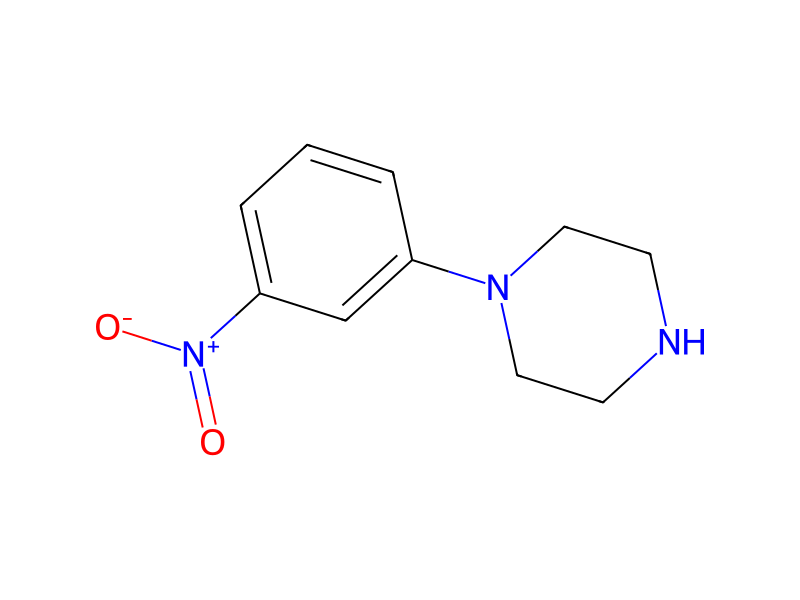
[N+:1]([C:4]1[CH:5]=[C:6]([N:10]2[CH2:15][CH2:14][NH:13][CH2:12][CH2:11]2)[CH:7]=[CH:8][CH:9]=1)([O-:3])=[O:2].Cl.C(=O)([O-])[O-].[K+].[K+].[F:23][CH2:24][CH2:25][CH2:26]I>C(#N)C.O>[F:23][CH2:24][CH2:25][CH2:26][N:13]1[CH2:14][CH2:15][N:10]([C:6]2[CH:7]=[CH:8][CH:9]=[C:4]([N+:1]([O-:3])=[O:2])[CH:5]=2)[CH2:11][CH2:12]1Participants






Procedure
To a suspension of 1-(3-nitro-phenyl)-piperazine; hydrochloride (1.0 g, 4.1 mmol) and potassium carbonate (0.62 g, 4.5 mmol) in acetonitrile (10 mL) was added 1-fluoro-3-iodo-propane (0.85 g, 4.5 mmol) and was stirred at room temperature for 3 days. The mixture was poured into water (50 mL) and extracted with dichloromethane (3×20 mL). The combined organic layers were washed with saturated aqueous sodium chloride (10 mL), dried over magnesium sulfate, filtered and evaporated. 1-(3-Fluoro-propyl)-4-(3-nitro-phenyl)-piperazine was isolated as a viscous orange oil (0.886 g, 80%). 1H NMR (400 MHz, CDCl3, δ, ppm): 7.71 (s, 1H), 7.65 (d, J=8.2 Hz, 1H), 7.37 (t, J=8.2 Hz, 1H), 7.18 (dd, J=8.3, 1.9 Hz, 1H), 4.54 (ddd, J=47.2, 5.9, 5.9 Hz, 2H), 3.32-3.27 (m, 4H), 2.65-2.60 (m, 4H), 2.55 (t, J=7.2 Hz, 2H), 2.00-1.85 (m, 2H). MS=268 (MH)+.
Workup
- extractionextracted with dichloromethane (3×20 mL)
- washThe combined organic layers were washed with saturated aqueous sodium chloride (10 mL)
- dry with materialdried over magnesium sulfate
- filtrationfiltered
- customevaporated
Sources & evidence
- ORD record
- ord-be3596e2277d4360ab273d425f424d5a
- Source dataset
- uspto-grants-2014_01
- Patent number
- US08633173B2
Reaction notes
Loading…