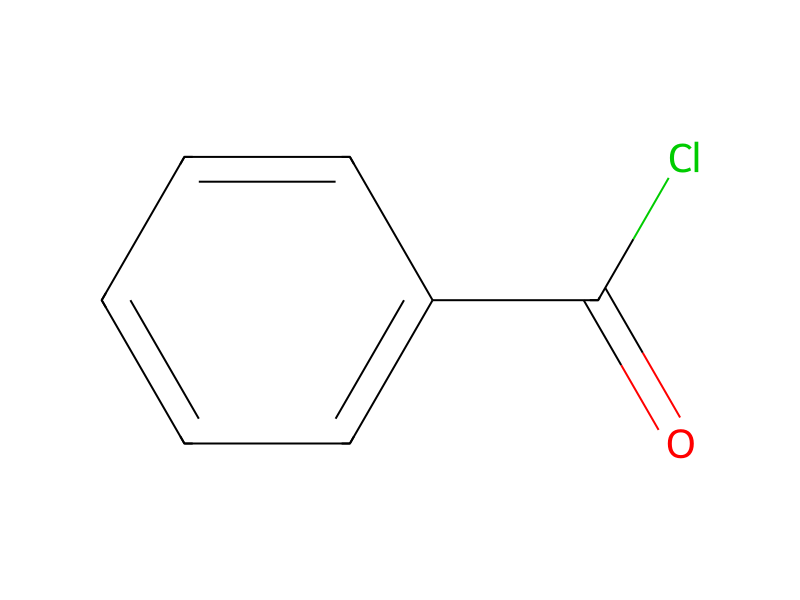
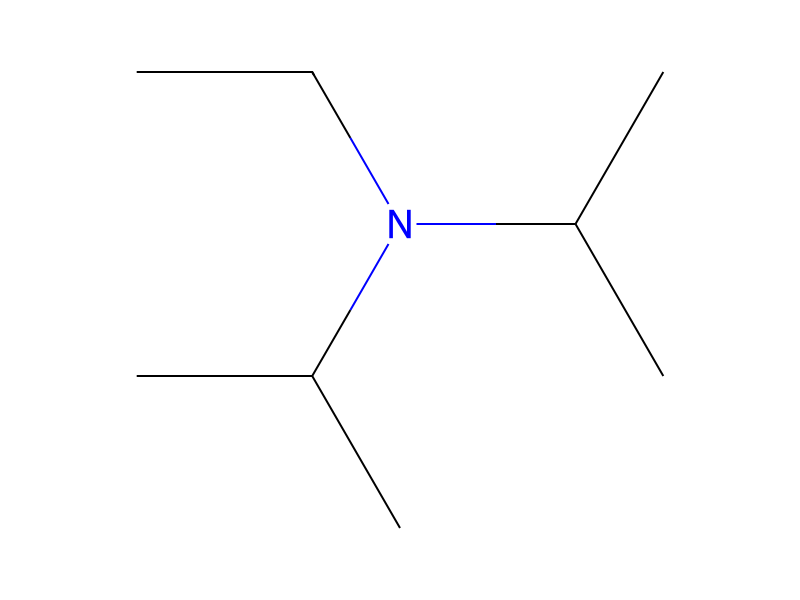
Benzoyl chloride → Diisopropylethylamine
Reaction equation

C(Cl)(=O)[C:2]1[CH:7]=[CH:6]C=CC=1.[N:10]1[CH:15]=[CH:14]C=[CH:12][CH:11]=1.Cl[CH2:17]Cl>CN(C1C=CN=CC=1)C>[CH3:14][CH2:15][N:10]([CH:7]([CH3:6])[CH3:2])[CH:11]([CH3:12])[CH3:17]Participants
Reactant 2

Product 1
Reagents, catalysts & solvents 1
Procedure
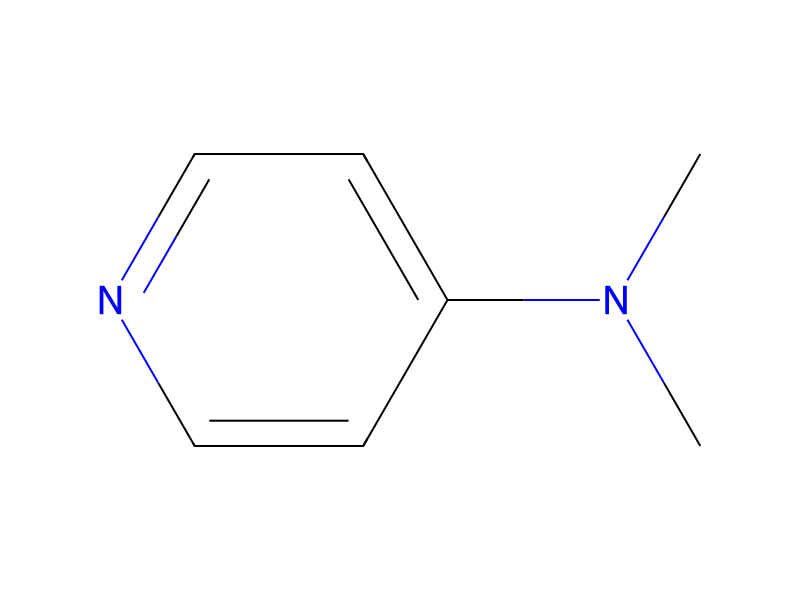
The following stages have been newly invented: using sodium azide in DMF, 29 was reacted to give the azide 30 and this was reduced with triphenylphosphine in pyridine to give the aminoethyluracil 31. The amino function in 31 was finally protected with N-ethoxycarbonylphtalimide (Scheme 2). Nucleosidation of ribose tetrabenzoate 33 with N-phtaloylaminoethyluracil 32 produced the ribose tribenzoate 34 in good yields. The anomeric centre of the pyranose ring is in the β configuration, as can be clearly seen from the coupling constants between H—C(1′) and H—C(2′) of J=9.5 Hz. Subsequent removal of the benzoate protective groups using NaOMe in MeOH yielded the linker triol 35. 35 was reacted with benzoyl chloride at −78° C. in pyridine/dichlormethane 1:10 in the presence of DMAP. In this process, in addition to the desired 2′-benzoate 36 (64%), 2′,4′-dibenzoylated product (22%) was also obtained, which was collected and converted into the triol 35 analogously to the methanolysis of 34 to 35. The 2′-benzoate 36 was tritylated with dimethoxytrityl chloride in the 4′-position in yields of greater than 90% in the presence of Hünig's base in dichloromethane. The rearrangement of 4′-DMT-2′-benzoate 37 to the 4′-DMT-3′-benzoate 38 was carried out in the presence of DMAP, p-nitrophenol and Hünig's base in n-propanol/pyridine 5:2. After chromatography, 38 is obtained. 4′-DMT-3′-benzoate 38 was finally reacted with ClP (OAll)N(iPr)2 to give the phosphoramidite 39 in the presence of Hu{umlaut over (n)}ig's base (Scheme 3). This can be employed for the automated oligonucleotide synthesis without alteration of the synthesis protocols.
Workup
- customSubsequent removal of the benzoate protective groups
- customyielded the linker triol 35
- customwas also obtained
- customwhich was collected
Sources & evidence
- ORD record
- ord-0a22227c27694e6ca4074e9b5db35ef8
- Source dataset
- uspto-grants-2004_03
- Patent number
- US06699978B1
Reaction notes
Loading…