Sodium Hydroxide → Sodium orthosilicate
Reaction equation

[O:1]=[Si]=O.[OH-].[Na+:5].[O-:6][Si:7]([O-:9])=[O:8].[Na+].[Na+]>O>[Si:7]([O-:1])([O-:9])([O-:6])[O-:8].[Na+:5].[Na+:5].[Na+:5].[Na+:5]Participants
Reactant 3


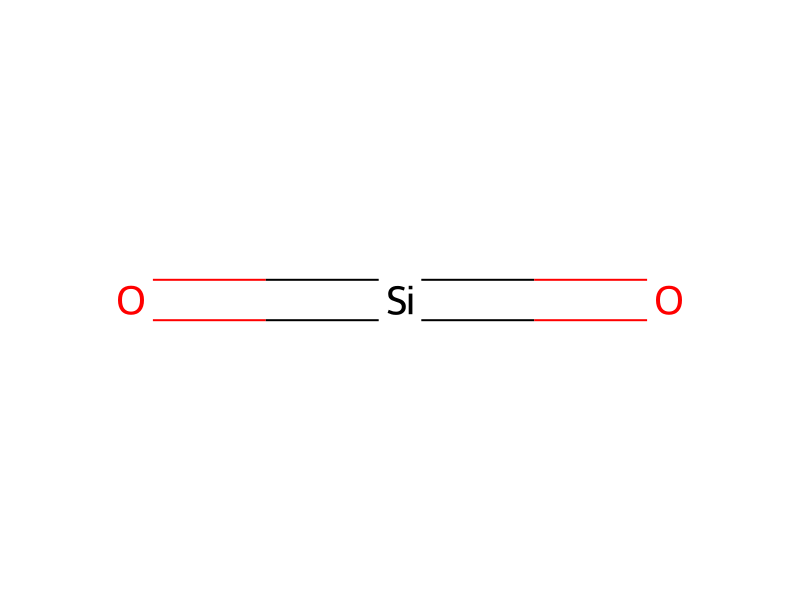
Product 1

Reagents, catalysts & solvents 1

Procedure
A process for producing amorphous sodium silicates having a water content of 0.3 to 6% by weight and an SiO2 /Na2O molar ratio of (1.9 to 2.8) : 1 from a waterglass solution containing at least 20% by weight of solids, the water-glass solution is obtained by reacting quartz sand with sodium hydroxide solution at an SiO2 /Na2O molar ratio of (2.0 to 2.8) : 1 at temperatures of 180 to 240° C. and pressures of 10 to 30 bar. This waterglass solution is treated in a spray-drying zone with hot air at 200 to 300° C. for a residence time of 10 to 20 seconds and at a temperature of the exit gas leaving the spray-drying zone of 90° to 130° C., to form a pulverulent amorphous sodium silicate having a water content (determined as the loss on ignition at 700° C.) of 15 to 23% by weight and a bulk density of more than 300 g/l. The pulverulent sodium silicate is introduced into an obliquely arranged rotary kiln fitted with devices for moving solids and treated therein with flue gas in countercurrent at temperatures from 250° up to 500° C. for 1 to 60 minutes. The rotary kiln is here insulated in such a way that its outside wall temperature is less than 60° C. Finally, the amorphous sodium silicate emerging from the rotary kiln is comminuted by means of a mechanical crusher to grain sizes of 0.1 to 12 mm.
Workup
- customat temperatures of 180 to 240° C. and pressures of 10 to 30 bar
- customleaving the spray-drying zone of 90° to 130° C.
Sources & evidence
- ORD record
- ord-242d1381df234e2b91b0f083955faa90
- Source dataset
- uspto-grants-1993_07
- Patent number
- US05229095
Reaction notes
Loading…