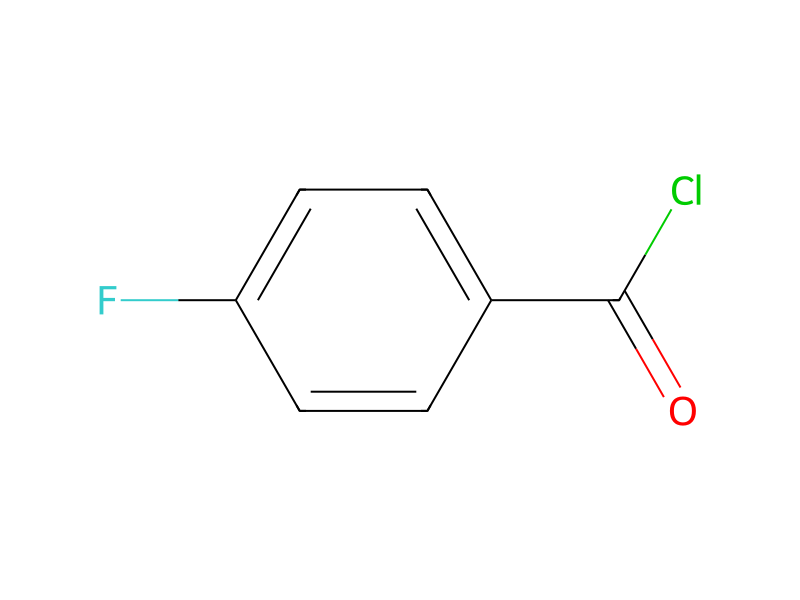
4-Fluorobenzoyl chloride → 2-[(2-Methyl-4-(4-fluorobenzamido)phenyl)amino]-1-pyrroline, hydrochloride
Reaction equation

Cl.Cl.[CH3:3][C:4]1[CH:9]=[C:8]([NH2:10])[CH:7]=[CH:6][C:5]=1[NH:11][C:12]1[CH2:16][CH2:15][CH2:14][N:13]=1.[F:17][C:18]1[CH:26]=[CH:25][C:21]([C:22]([Cl:24])=[O:23])=[CH:20][CH:19]=1>C(#N)C.C(OCC)C>[ClH:24].[CH3:3][C:4]1[CH:9]=[C:8]([NH:10][C:22](=[O:23])[C:21]2[CH:25]=[CH:26][C:18]([F:17])=[CH:19][CH:20]=2)[CH:7]=[CH:6][C:5]=1[NH:11][C:12]1[CH2:16][CH2:15][CH2:14][N:13]=1Participants
5
Reactant 2

Product 1

Reagents, catalysts & solvents 2


Procedure
A mixture of 1.0 g (3.8 mmole) of product compound of Example 9 and 30.5 mmole of p-fluorobenzoyl chloride in 40 ml of acetonitrile was stirred at reflux for four hours, after which time thin-layer chromatography on silica gel (9:1 ethanol/concentrated aqueous ammonia) indicated no unreacted starting amine. The reaction mixture was then diluted eight-fold with diethyl ether. The resultant solid was collected and washed with three portions of ether, then dried in a high vacuum over 5A molecular sieves, giving the title compound as the hydrochloride salt. Structure assignment was supported by the nmr spectrum and by elemental analysis.
Workup
- temperatureat reflux for four hours
- customThe resultant solid was collected
- washwashed with three portions of ether
- dry with materialdried in a high vacuum over 5A molecular sieves
Sources & evidence
- ORD record
- ord-6aa09732f1ee488fa71abb5963290fc5
- Source dataset
- uspto-grants-1985_08
- Patent number
- US04533739
Reaction notes
Loading…