HuagongsheHuagongshe Chemistry Print Report · For research reference only
HRID 487455Generated: October 26, 2026
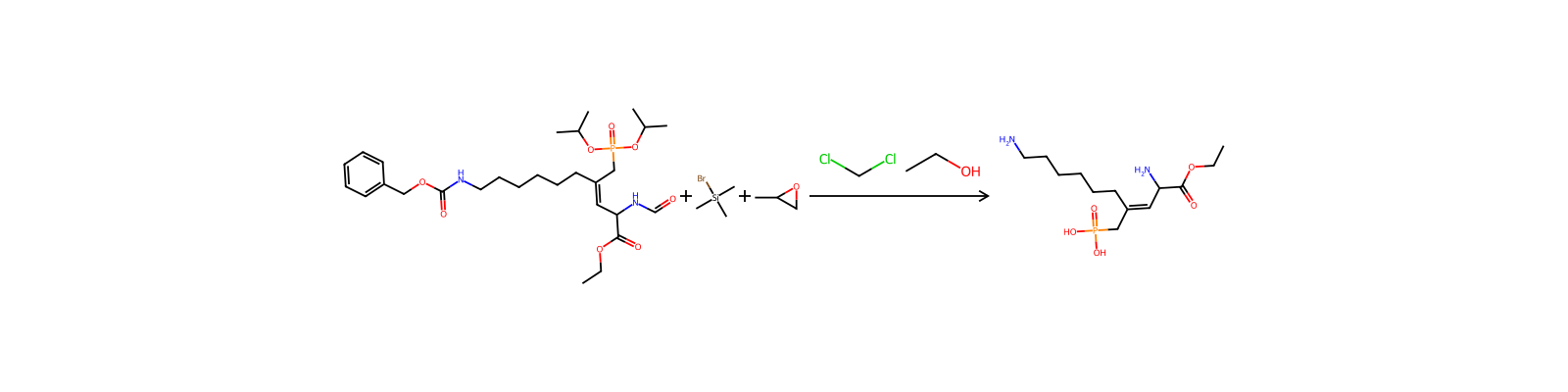
Propylene Oxide → 2,10-Diamino-4-phosphonomethyl-dec-3-enoic acid ethyl ester
https://huagongshe.com/reaction/487455
Participants
| Role | Name | HCID | Charge |
|---|
| Reactant | Propylene Oxide | HCID 6378 | — |
| Reactant | Bromotrimethylsilane | HCID 76113 | — |
| Reactant | 10-(N-benzyloxycarbonylamino)-4-diisopropylphosphonomethyl-2-formylaminodec-3-enoic acid ethyl ester | HCID 53755068 | — |
| Solvent | Ethanol | HCID 702 | — |
| Solvent | Dichloromethane | HCID 6344 | — |
| Product | 2,10-Diamino-4-phosphonomethyl-dec-3-enoic acid ethyl ester | HCID 53828018 | 58.4% |
Reaction Steps
8.63 g (15.2 mmol) of 10-(N-benzyloxycarbonylamino)-4-diisopropylphosphonomethyl-2-formylamino-dec-3-enoic acid ethyl ester are dissolved in 22 ml of dichloromethane, and 9.82 ml (75.9 mmol) of trimethylbromosilane are added dropwise at room temperature. The mixture is stirred at room temperature for 22 hours, 22 ml of absolute ethanol are then added dropwise, and the mixture is stirred for a further 22 hours and concentrated by evaporation in a rotary evaporator. 20 ml of toluene are poured over the residue, and the mixture is concentrated by evaporation in vacuo. This operation is repeated a further three times. The resulting pale yellow foam is dissolved in 150 ml of absolute ethanol, and a solution of 7.5 ml of propylene oxide in 7.5 ml of ethanol is added dropwise within a period of 90 minutes. A crystalline suspension forms, which is stirred overnight at room temperature. The product is filtered off and washed with ethanol and ether. Drying under a high vacuum at room temperature yields 4.70 g of crude product in the form of pale yellow crystals. For further purification, the product is stirred with 46 ml of water. After a small amount (0.33 g) of undissolved material has been filtered off, the clear pale yellow filtrate is completely concentrated by evaporation in vacuo. 20 ml of ethanol and 20 ml of toluene are added to the residue, and the mixture is again concentrated to dryness by evaporation. This operation is repeated twice more using toluene. After drying under a high vacuum, the residue is suspended in 150 ml of absolute ethanol, and a 5-normal solution of hydrogen chloride gas in ethanol is added dropwise, with stirring, until the mixture gives an acid reaction to Congo red. A mixture of 7.4 ml of propylene oxide in 7.4 ml of ethanol is added dropwise to the resulting clear solution within a period of one hour. A crystalline suspension forms, which is stirred for a further 15 hours and then filtered with suction. After washing with ethanol and ether, the product is dried under a high vacuum at 50° for 48 hours, yielding 2.86 g of 2,10-diamino-4-phosphonomethyl-dec-3-enoic acid ethyl ester, which begins to sinter at 157° and melts at 194° with decomposition.
Provenance & Evidence
| DOI | 10.6084/m9.figshare.5104873.v1 |
|---|
| Patent number | US05294734 |
|---|
| Source dataset | uspto-grants-1994_03 |
|---|
| ORD ID | ord-8154d4160b534791b17d98c053297b78 |
|---|
| Source note | uspto-grants-1994_03 |
|---|