Chlorosulfonyl isocyanate → 4-Chloro-3-cyanomethyl-indole-1-carboxylic acid amide
Reaction equation

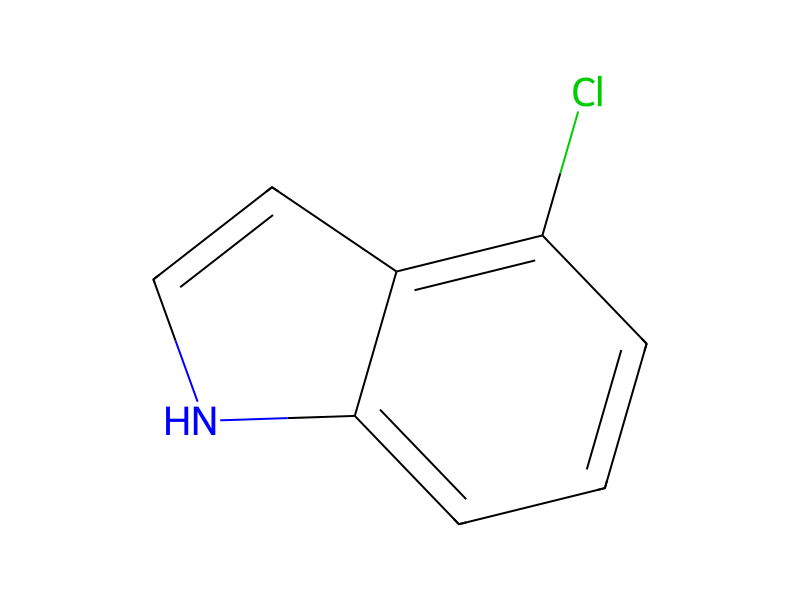
[Cl:1][C:2]1[CH:10]=[CH:9][CH:8]=[C:7]2[C:3]=1[C:4]([CH2:11][C:12]#[N:13])=[CH:5][NH:6]2.ClC1C=CC=C2C=1C=CN2.ClS([N:28]=[C:29]=[O:30])(=O)=O>ClCCl>[Cl:1][C:2]1[CH:10]=[CH:9][CH:8]=[C:7]2[C:3]=1[C:4]([CH2:11][C:12]#[N:13])=[CH:5][N:6]2[C:29]([NH2:28])=[O:30]Participants




Procedure
The (4-chloro-1H-indol-3-yl)-acetonitrile used in step 1 was prepared from commercially obtained 4-chloro-1H-indole (Aldrich Chemical Co. Cat. No. 24,622-0) using the procedure of steps 4 and 5 of Example 1. To (4-chloro-1H-indol-3-yl)-acetonitrile (500 mg, 2.62 mmol) dissolved in anhydrous dichloromethane (10 mL) was added chlorosulfonyl isocyanate (0.92 mL, 10.50 mmol). After 1.5 hours, the reaction was filtered and the resulting solid was washed with dichloromethane. The solid was then dissolved in acetone and water (2.5 mL) was added. The reaction mixture was concentrated to dryness to yield 4-Chloro-3-cyanomethyl-indole-1-carboxylic acid amide as a pale pink solid (377 mg, 62%). 1H NMR (DMSO-d6) δ: 4.27 (br s, 2H), 7.28 (m, 2H), 7.78 (br s, 2H), 7.98 (s, 1H), 8.28 (m, 1H); M+233.
Workup
- filtrationthe reaction was filtered
- washthe resulting solid was washed with dichloromethane
- dissolutionThe solid was then dissolved in acetone
- additionwater (2.5 mL) was added
- concentrationThe reaction mixture was concentrated to dryness
Sources & evidence
- ORD record
- ord-9a6232b7bffd4d36b799857a3f6d7f52
- Source dataset
- uspto-grants-2005_12
- Patent number
- US06979696B2
Reaction notes
Loading…