Acetic Acid → HCID 23153143, compound
Reaction equation

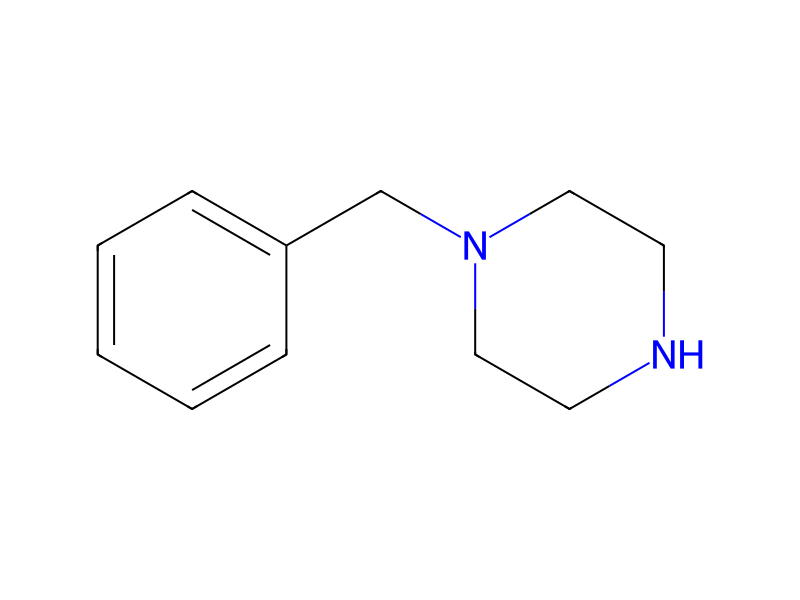
[C:1]([N:8]1[CH2:11][C:10](=O)[CH2:9]1)([O:3][C:4]([CH3:7])([CH3:6])[CH3:5])=[O:2].C(O)(=O)C.[CH2:17]([N:24]1[CH2:29][CH2:28][NH:27][CH2:26][CH2:25]1)[C:18]1[CH:23]=[CH:22][CH:21]=[CH:20][CH:19]=1>CO.[C].[Pd]>[CH2:17]([N:24]1[CH2:29][CH2:28][N:27]([CH:10]2[CH2:11][N:8]([C:1]([O:3][C:4]([CH3:7])([CH3:6])[CH3:5])=[O:2])[CH2:9]2)[CH2:26][CH2:25]1)[C:18]1[CH:19]=[CH:20][CH:21]=[CH:22][CH:23]=1Participants





Procedure
After adding 1-Boc-azetidin-3-one (495 mg) and acetic acid (0.182 ml) to a solution of 1-benzylpiperazine (0.500 ml) in methanol (25 ml), the mixture was stirred for 5 minutes at room temperature. Then, 10% palladium-carbon (308 mg) was added thereto and the mixture was stirred for 15 hours at room temperature under a hydrogen atmosphere. The catalyst was then filtered. The residue was partitioned between ethyl acetate and saturated aqueous sodium hydrogencarbonate. The organic layer was washed with brine and then dried over anhydrous sodium sulfate. It was concentrated to provide a crude product of 4-benzyl-1-(1-Boc-azetidin-3-yl)piperazine (ESI-MS (m/z): 332[M+H]+). It was dissolved in tetrahydrofuran (10 ml). Lithium aluminum hydride (219 mg) was then added thereto while stirring the mixture in an ice bath. After stirring for 15 minutes in an ice bath under a nitrogen atmosphere and for 15 minutes at room temperature, the mixture was heated to reflux for 3.5 hours at 100° C. The reaction mixture was cooled in an ice bath. Water (0.22 ml), 5N aqueous sodium hydroxide (0.22 ml) and water (1.1 ml) were added thereto, and the mixture was stirred in an ice bath for 1 hour. The insoluble portion was filtered. A solution of 4N hydrochloric acid-ethyl acetate (2.17 ml) was added to the filtrate, and the mixture was concentrated to provide a crude product of 4-benzyl-1-(1-methylazetidin-3-yl)piperazine trihydrochloride (ESI-MS (m/z): 246[M+H]+). It was dissolved in water (25 ml) and 2-propanol (25 ml). After adding 10% palladium-carbon (615 mg), the mixture was stirred for 12 hours at room temperature under a hydrogen atmosphere. The catalyst was filtered. The filtrate was concentrated to provide a crude product of the title compound (382 mg) as a white solid.
Workup
- stirringthe mixture was stirred for 15 hours at room temperature under a hydrogen atmosphere
- filtrationThe catalyst was then filtered
- customThe residue was partitioned between ethyl acetate and saturated aqueous sodium hydrogencarbonate
- washThe organic layer was washed with brine
- dry with materialdried over anhydrous sodium sulfate
- concentrationIt was concentrated
Sources & evidence
- ORD record
- ord-5d49fad2b3114f1799844f655e59a7a2
- Source dataset
- uspto-grants-2009_05
- Patent number
- US07531532B2
Reaction notes
Loading…