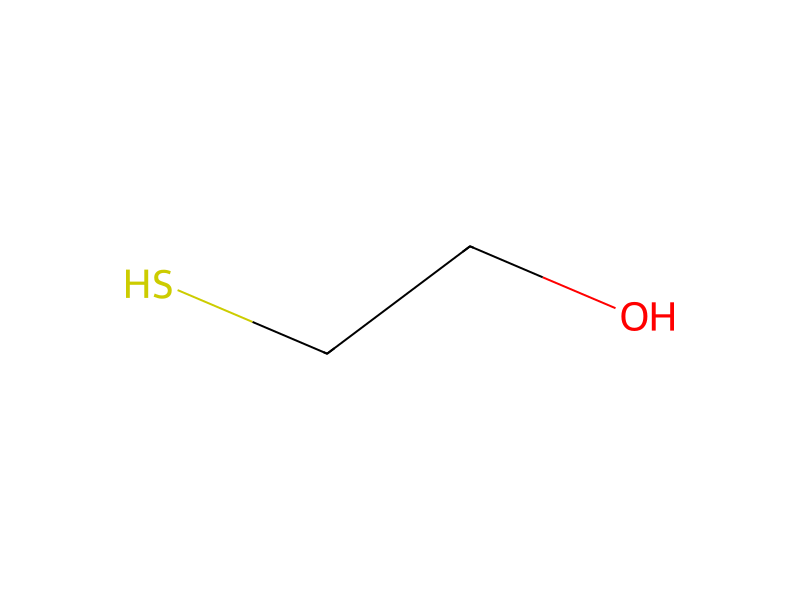
2-Mercaptoethanol → HCID 22036258, compound
Reaction equation

[OH-].[Na+].[SH:3][CH2:4][CH2:5][OH:6].Cl[C:8]1[C:13]([N:14]2[CH2:19][CH2:18][N:17]([C:20]([O:22][C:23]([CH3:26])([CH3:25])[CH3:24])=[O:21])[CH2:16][CH2:15]2)=[N:12][CH:11]=[CH:10][N:9]=1>O.O1CCOCC1>[OH:6][CH2:5][CH2:4][S:3][C:8]1[C:13]([N:14]2[CH2:15][CH2:16][N:17]([C:20]([O:22][C:23]([CH3:26])([CH3:25])[CH3:24])=[O:21])[CH2:18][CH2:19]2)=[N:12][CH:11]=[CH:10][N:9]=1Participants
6





Conditions
- Temperature
- 100 °C
Procedure
Sodium hydroxide (0.92 g, 23 mmol) was dissolved in water (9 mL) and dioxane (15 mL). 2-Mercaptoethanol (0.54 mL, 7.7 mmol) was added while stirring and 2-chloro-3-(4-tert-butoxycarbonyl-1-piperazinyl)pyrazine (2.3 g, 7.7 mmol, from Example 52, step 1) in dioxane (10 mL) was added. The reaction mixture was heated at 100° C. for 22 h. After cooling to room temperature, it was extracted with EtOAc. The organic layer was dried (K2CO3) and the solvent was removed under reduced pressure. The residue was purified by chromatography on silica gel using hexane/ EtOAc (1:1) as eluent to give 1.71 g (65%) of the title compound as an orange oil. MS m/z 341 (M+H)+.
Workup
- temperatureAfter cooling to room temperature
- extractionit was extracted with EtOAc
- dry with materialThe organic layer was dried (K2CO3)
- customthe solvent was removed under reduced pressure
- customThe residue was purified by chromatography on silica gel
Sources & evidence
- ORD record
- ord-11fdea6c19974d80a7652e17fcd16d31
- Source dataset
- uspto-grants-2009_05
- Patent number
- US07534794B2
Reaction notes
Loading…