Dichloromethane → 4-(5-Chloro-benzo[b]thiophen-3-yl)-pyridine
Reaction equation

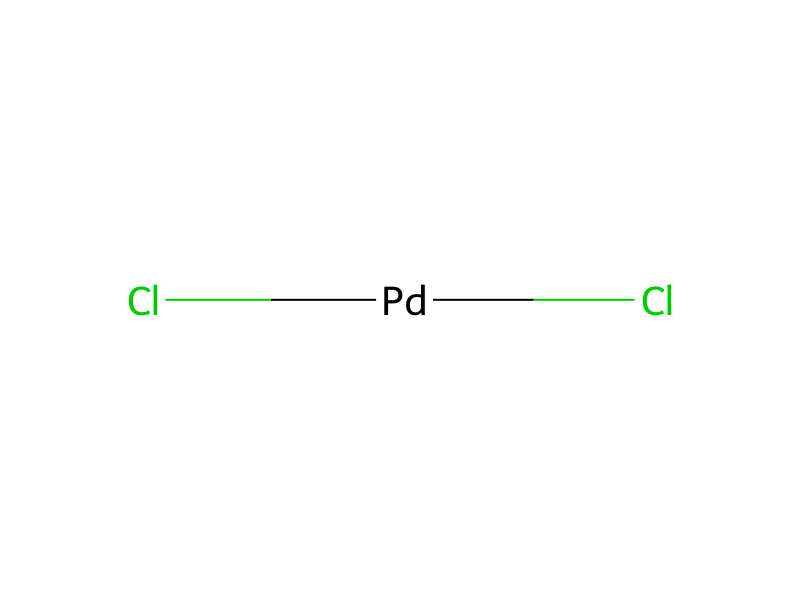
Br[C:2]1[C:3]2[CH:10]=[C:9]([Cl:11])[CH:8]=[CH:7][C:4]=2[S:5][CH:6]=1.[N:12]1[CH:17]=[CH:16][C:15](B(O)O)=[CH:14][CH:13]=1.[O-]P([O-])([O-])=O.[K+].[K+].[K+].C(Cl)Cl>Cl[Pd]Cl.O.O1CCOCC1>[Cl:11][C:9]1[CH:8]=[CH:7][C:4]2[S:5][CH:6]=[C:2]([C:15]3[CH:16]=[CH:17][N:12]=[CH:13][CH:14]=3)[C:3]=2[CH:10]=1Participants
Reactant 4




Product 1

Reagents, catalysts & solvents 3


Procedure
To 3-bromo-5-chloro-benzo[b]thiophene (9.80 g, 39.6 mmol) was added pyridine-4-boronic acid (4.445 g, 36.2 mmol), K3PO4 (19.5 g, 91.9 mmol), 61 mL of 1,4-dioxane and 6 mL of water. The mixture was placed under house vacuum for several minutes and flushed with nitrogen. This was repeated 5 times. Pd(dppf)Cl2.CH2Cl2 (2.71 g, 3.31 mmol), PdCl2 (0.0563 g, 0.318 mmol) and 1,1″-bis(diphenylphosphino)ferrocene (0.1747 g, 0.3151 mmol) were purged in the same way. The catalyst was added to the reaction flask which was purged with nitrogen 3 more times. The mixture was stirred (stir bar) at 80° C. for 22 hours. TLC showed little change. The mixture was mechanically stirred at 80° C. for 4 hours. The mixture was partitioned between water and ethyl acetate, filtered through Celite and the layers were separated. The organic layer was evaporated. The residue was dissolved in ethyl acetate, washed with water twice. Saturated brine was added the second time to separate the layers more quickly. The organic solution was dried over magnesium sulfate. Filtration and contration in vacuum gave 11.35 g of black oil. This was eluted from silica gel with a gradient of hexane and ethyl acetate to give 3.86 g of recovered starting material and 4.28 g of the title compound as light brown crystals, m.p. 90-91° C.
Workup
- waitThe mixture was placed under house vacuum for several minutes
- customflushed with nitrogen
- additionThe catalyst was added to the reaction flask which
- customwas purged with nitrogen 3 more times
- stirring(stir bar) at 80° C. for 22 hours
- stirringThe mixture was mechanically stirred at 80° C. for 4 hours
- customThe mixture was partitioned between water and ethyl acetate
- filtrationfiltered through Celite
- customthe layers were separated
- customThe organic layer was evaporated
- dissolutionThe residue was dissolved in ethyl acetate
- washwashed with water twice
- additionSaturated brine was added the second time
- customto separate the layers more quickly
- dry with materialThe organic solution was dried over magnesium sulfate
- filtrationFiltration and contration in vacuum
Sources & evidence
- ORD record
- ord-cee34bd5b62c4b3bb8b7af684b163406
- Source dataset
- uspto-grants-2005_09
- Patent number
- US06939877B2
Reaction notes
Loading…