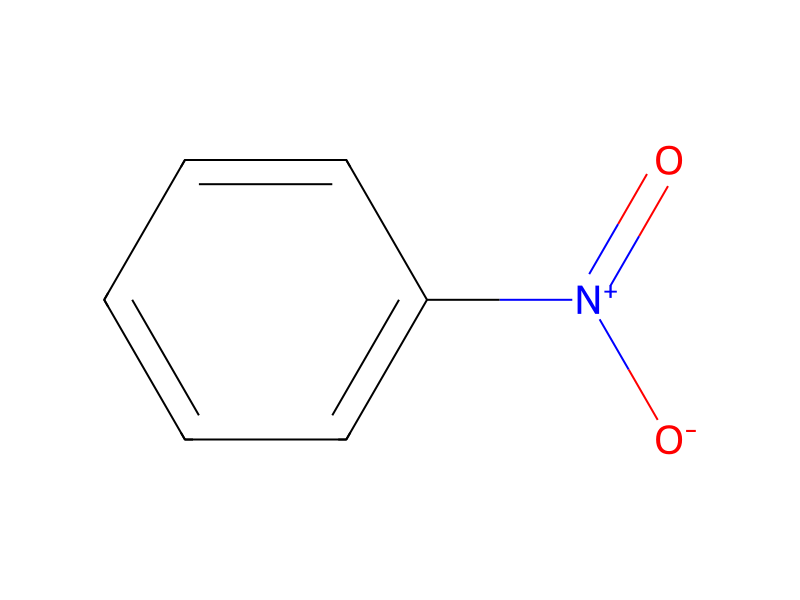
Nitrobenzene → HCID 178526432, compound
Reaction equation

[N+:1]([C:4]1[CH:5]=[CH:6][CH:7]=[CH:8][CH:9]=1)([O-:3])=[O:2].[N+](C1C=[CH:15][CH:16]=[C:17](N)[C:18]=1[C:19](O)=O)([O-])=O.C(C1C=CC=C1)(C)C>>[N+:1]([C:4]1[CH:9]=[CH:8][C:7]2[C:18]3[CH2:19][C:15]([C:6]=2[CH:5]=1)=[CH:16][CH:17]=3)([O-:3])=[O:2]Participants


Procedure
In the synthesis shown in Scheme 1, a 3-nitrobenzene, generated from a 6-nitro-anthranilic acid (A), is reacted with a cyclic 1,4-diene (B), such as 5-isopropyl-cyclopentadiene, to form a 5-nitro-benzonorbornadiene (C) in a Diels-Alder reaction. Under standard catalytic reduction conditions (for example, using Raney nickel or palladium on carbon in a solvent such as methanol), both the 5-nitro group and the 2,3-double bond of the 5-nitro-benzonorbornadiene (C) are reduced to form the 5-amino-benzonorbornene (D). Reaction of the 5-amino-benzonorbornene (D) with a heterocyclyl-carboxylic acid or heterocyclyl-carboxylic acid derivative (E), where Q may be hydroxyl, fluoro, chloro or bromo, in a solvent such as dichloromethane gives a fungicidal heterocyclyl-carboxylic acid benzonorbornen-5-yl-amide (F). An example of (D) is 5-amino-9-isopropyl-benzonorbornene, which is a precursor of an amide of, for example, 3-difluoromethyl-1-methyl-1H-pyrazole-4-carboxylic acid.
Sources & evidence
- ORD record
- ord-7ad760f6fc734b1ebc207736c6a63b16
- Source dataset
- uspto-grants-2010_08
- Patent number
- US07781615B2
Reaction notes
Loading…