Hydrochloric Acid → N-benzylpyrido[3,2-d]pyrimidin-4-amine
Reaction equation

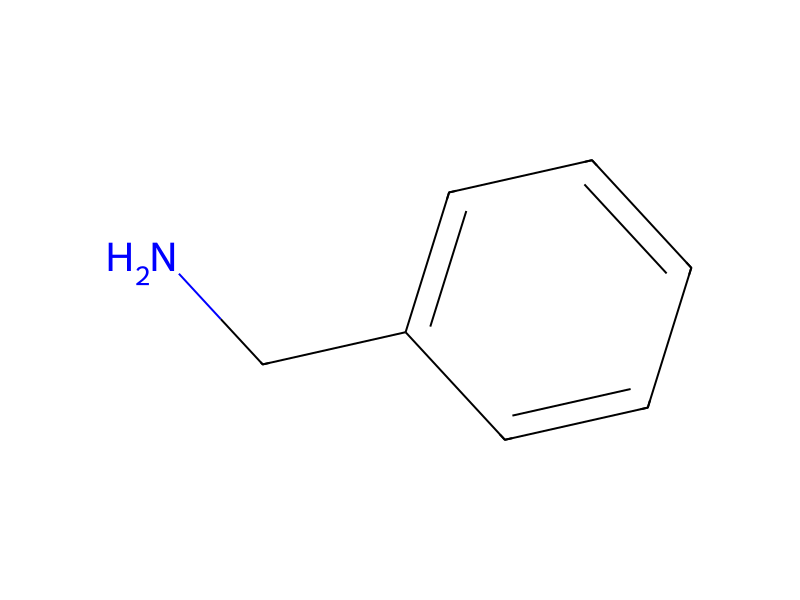
Cl[C:2]1[C:3]2[N:11]=[CH:10][CH:9]=[CH:8][C:4]=2[N:5]=[CH:6][N:7]=1.[CH2:12]([NH2:19])[C:13]1[CH:18]=[CH:17][CH:16]=[CH:15][CH:14]=1.Cl>CC(O)C>[CH2:12]([NH:19][C:2]1[C:3]2[N:11]=[CH:10][CH:9]=[CH:8][C:4]=2[N:5]=[CH:6][N:7]=1)[C:13]1[CH:18]=[CH:17][CH:16]=[CH:15][CH:14]=1Participants
5
Reactant 3


Product 1

Reagents, catalysts & solvents 1

Conditions
- Temperature
- 50 °C
Procedure
A solution of freshly prepared 4-chloropyrido[3,2-d]pyrimidine (0.10 g, 0.60 mmol) (prepared as described in the previous experimental) and benzylamine (0.13 mL, 1.20 mmol) in propan-2-ol (15 mL) containing a trace of conc. HCl is warmed at 50° C. for 30 min, and then concentrated to dryness. The residue is partitioned between water and EtOAc, and the organic layer worked up and chromatographed on silica gel. EtOAc elutes foreruns, while MeOH/EtOAc (1:9) elutes 4-(benzylamino)pyrido[3,2-d]pyrimidine (0.11 g, 77%). 1H NMR (CDCl3) δ 8.67 (1H, s), 6.50 (1H, dd, J=4.3, 1.5 Hz), 8.10 (1H, dd, J=8.5, 1.5 Hz), 7.63 (1H, dd, J=8.8, 4.3 Hz), 7.55 (1H, brs) 7.41-7.29 (5H, m), 4.86 (2H, d, J=5.9 Hz)
Workup
- concentrationconcentrated to dryness
- customThe residue is partitioned between water and EtOAc
- customchromatographed on silica gel
Sources & evidence
- ORD record
- ord-6b1bcc33f4754982a621ba44ff13f51a
- Source dataset
- uspto-grants-2004_03
- Patent number
- US06713484B2
Reaction notes
Loading…