N-Methylmorpholine N-oxide monohydrate → 5-(3,5-Difluorobenzoyl)-2-fluorobenzonitrile
Reaction equation

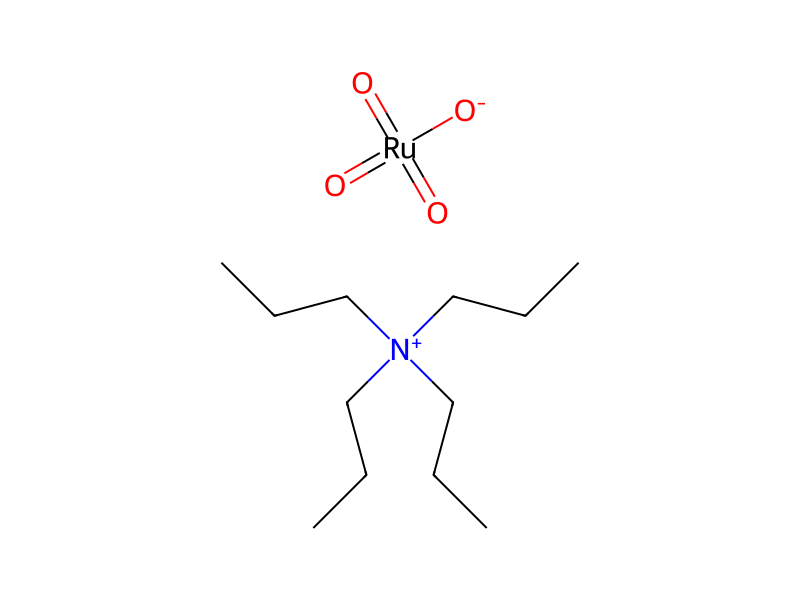
[F:1][C:2]1[CH:3]=[C:4]([CH:9]([OH:19])[C:10]2[CH:11]=[CH:12][C:13]([F:18])=[C:14]([CH:17]=2)[C:15]#[N:16])[CH:5]=[C:6]([F:8])[CH:7]=1.O.C[N+]1([O-])CCOCC1>ClCCl.[Ru]([O-])(=O)(=O)=O.C([N+](CCC)(CCC)CCC)CC>[F:1][C:2]1[CH:3]=[C:4]([CH:5]=[C:6]([F:8])[CH:7]=1)[C:9]([C:10]1[CH:11]=[CH:12][C:13]([F:18])=[C:14]([CH:17]=1)[C:15]#[N:16])=[O:19]Participants
5
Reactant 2


Product 1

Reagents, catalysts & solvents 2

Procedure
A mixture of 5-[(3,5-Difluoro-phenyl)-hydroxy-methyl]-2-fluoro-benzonitrile (2.68 g, 10.2 mmol), 4-methylmorpholine N-oxide monohydrate (2.02 g, 15 mmol) and tetrapropylammonium perruthenate (35 mg, 0.1 mmol) in dry dichloromethane (50 mL) was stirred at room temperature for 2 hours. The reaction mixture was evaporated and the residue redissolved in ethyl acetate. The organic phase was washed with 10% sodium bisulphite and saturated ammonium chloride, dried and evaporated. Purification of the crude by chromatography over silica gel (EtOAc/hexane) afforded 2.05 g of the title compound (77% yield).
Workup
- customThe reaction mixture was evaporated
- dissolutionthe residue redissolved in ethyl acetate
- washThe organic phase was washed with 10% sodium bisulphite and saturated ammonium chloride
- customdried
- customevaporated
- customPurification of the crude by chromatography over silica gel (EtOAc/hexane)
Sources & evidence
- ORD record
- ord-a6413daf7a2d46ba85dd4ec0ffbc9114
- Source dataset
- uspto-grants-2015_08
- Patent number
- US09102662B2
Reaction notes
Loading…