Ethylene Glycol → 2-(5-Bromo-2-fluorophenyl)-1,3-dioxolane
Reaction equation

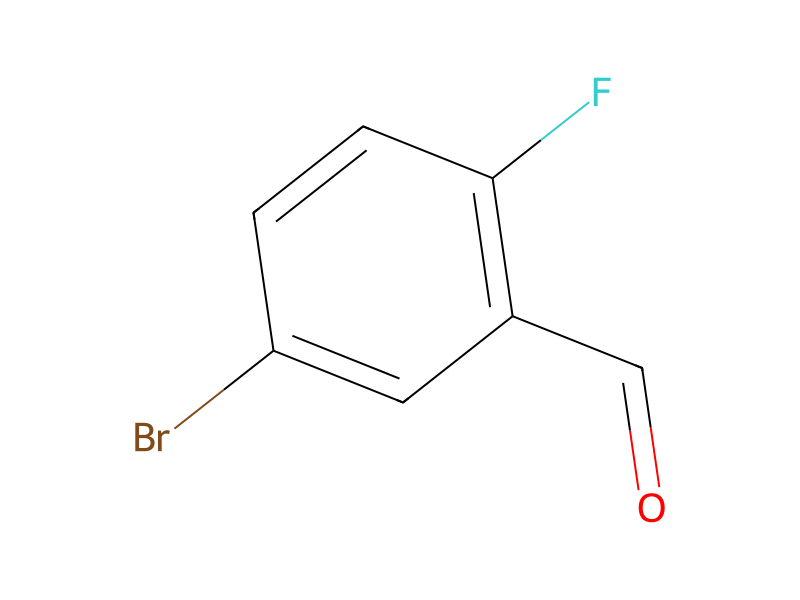
[Br:1][C:2]1[CH:3]=[CH:4][C:5]([F:10])=[C:6]([CH:9]=1)[CH:7]=[O:8].[CH2:11](O)[CH2:12][OH:13].C1(C)C=CC(S(O)(=O)=O)=CC=1>C1(C)C=CC=CC=1>[Br:1][C:2]1[CH:3]=[CH:4][C:5]([F:10])=[C:6]([CH:7]2[O:13][CH2:12][CH2:11][O:8]2)[CH:9]=1Participants
5
Reactant 3


Product 1

Reagents, catalysts & solvents 1

Procedure
To a 3 neck round bottom flask, fitted with a Dean-Stark apparatus, was added 5-bromo-2-fluorobenzaldehyde (5 g, 24.6 mmol), ethane-1,2-diol (4.12 ml, 73.9 mmol), and p-toluenesulfonic acid (424 mg, 2.46 mmol). The resulting mixture was placed under nitrogen, dissolved in anhydrous toluene (100 ml) and heated under reflux for 18 h. After cooling, the mixture was concentrated in vacuo. The residue was diluted with EtOAc (50 ml) and the organic phase was washed with sat. NaHCO3 solution (30 ml), brine (30 ml), dried (Na2SO4) and concentrated in vacuo. The crude residue was purified by column chromatography with heptane/EtOAc (95:5) as the eluent to give the title compound (4.69 g, 77%). The structure was confirmed by 1H NMR.
Workup
- customTo a 3 neck round bottom flask, fitted with a Dean-Stark apparatus
- temperatureheated
- temperatureunder reflux for 18 h
- temperatureAfter cooling
- concentrationthe mixture was concentrated in vacuo
- additionThe residue was diluted with EtOAc (50 ml)
- washthe organic phase was washed with sat. NaHCO3 solution (30 ml), brine (30 ml)
- dry with materialdried (Na2SO4)
- concentrationconcentrated in vacuo
- customThe crude residue was purified by column chromatography with heptane/EtOAc (95:5) as the eluent
Sources & evidence
- ORD record
- ord-c6c4602c56e7453eb347e2f3f6ab14c7
- Source dataset
- uspto-grants-2015_08
- Patent number
- US09102688B2
Reaction notes
Loading…