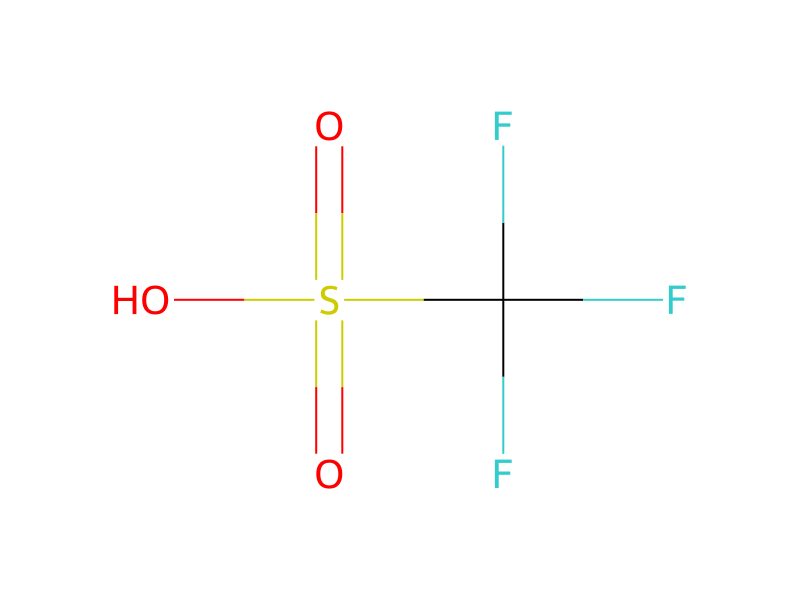
Trifluoromethanesulfonic acid → 6-bromo-3-methyl-3,4-dihydronaphthalen-1(2H)-one
Reaction equation

FC(F)(F)S(O)(=O)=O.[Br:9][C:10]1[CH:11]=[C:12]([CH2:16][CH:17]([CH3:22])[CH2:18][C:19]([OH:21])=O)[CH:13]=[CH:14][CH:15]=1>C(Cl)Cl.C(Cl)(Cl)Cl>[Br:9][C:10]1[CH:11]=[C:12]2[C:13](=[CH:14][CH:15]=1)[C:19](=[O:21])[CH2:18][CH:17]([CH3:22])[CH2:16]2Participants




Conditions
- Temperature
- 0 °C
Procedure
A flask was charged with trifluoromethane sulfonic acid (450 g, 3 mol) and cooled to 0° C. with an ice-water bath. 4-(3-bromophenyl)-3-methylbutanoic acid, prepared in a similar manner as described in Example 32 (15.5 g, 60 mmol), was added as a solution in DCM (30 mL) slowly to produce a clear dark brown solution. After 15 min, the reaction was diluted with 500 mL of CHCl3 and poured slowly onto approximately 1 L of crushed ice. The resulting slurry was allowed to stir until the solution warms to room temperature and became biphasic. Following separation of layers, the aqueous layer was extracted with CHCl3. The combined organics were washed with brine and dried over anhydrous MgSO4 prior to concentration in vacuo. Purification via Isco column chromatography (50% DCM/hex isocratic) provided a quantitative yield of the named compound as a pale yellow amorphous solid. LCMS-ESI+ (m/z): [M]+ calcd for C11H11BrO: 239.11; found: 239.20.
Workup
- customto produce a clear dark brown solution
- customwarms to room temperature
- customseparation of layers
- extractionthe aqueous layer was extracted with CHCl3
- washThe combined organics were washed with brine
- dry with materialdried over anhydrous MgSO4
- concentrationto concentration in vacuo
- customPurification via Isco column chromatography (50% DCM/hex isocratic)
Sources & evidence
- ORD record
- ord-1d78bf7c376a4fdd86124431795d2d10
- Source dataset
- uspto-grants-2015_08
- Patent number
- US09102614B2
Reaction notes
Loading…