4-Methylpyridine → Disodium
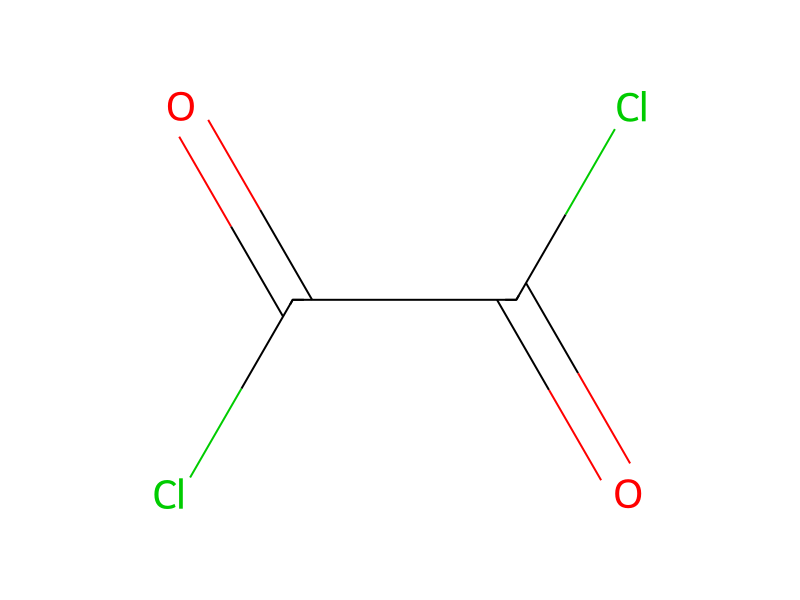
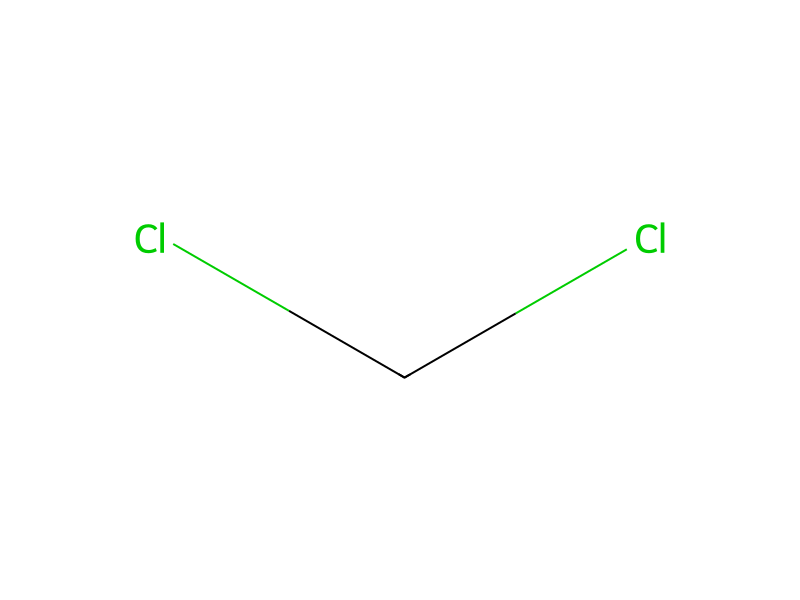
Reaction equation

[F:1][C:2]([F:17])([F:16])[C:3]1[CH:4]=[C:5]([CH:9]([C:13]([O-:15])=O)[C:10]([O-:12])=O)[CH:6]=[CH:7][CH:8]=1.[Na+:18].[Na+:19].C(N1CCCCC1)=O.C(Cl)(=O)C(Cl)=O.FC(F)(F)C1C=C(C(C(Cl)=O)C(Cl)=O)C=CC=1.[N:51]1[CH:56]=[C:55]([CH2:57][NH:58][C:59]2[CH:64]=[CH:63][CH:62]=[CH:61][N:60]=2)[CH:54]=[N:53][CH:52]=1.N1C=CC(C)=CC=1>ClCCl>[OH:15][C:13]1[N+:58]([CH2:57][C:55]2[CH:54]=[N:53][CH:52]=[N:51][CH:56]=2)=[C:59]2[CH:64]=[CH:63][CH:62]=[CH:61][N:60]2[C:10](=[O:12])[C:9]=1[C:5]1[CH:6]=[CH:7][CH:8]=[C:3]([C:2]([F:1])([F:17])[F:16])[CH:4]=1.[Na:18][Na:19]Participants
Reactant 6




Product 2


Reagents, catalysts & solvents 1
Conditions
- Temperature
- 10 °C
Procedure
To a stirred mixture of sodium 2-[3-(trifluoromethyl)phenyl]propanedioate (2:1) (i.e. the product from Example 3A, Step A) (5.0 g, 95.0 area %, 16 mmol) and dichloromethane (50 mL) in a 250-mL round bottom flask at −1° C. was added 1-formylpiperidine (0.09 g, 0.8 mmol). Oxalyl chloride (5.6 g, 98%, 43 mmol) was then added via addition funnel over 5 min while maintaining the internal temperature at between −3 and +1° C. The resulting reaction mixture was stirred at between −3 and +2° C. for 10 min, then at 20−22° C. for 2-3 h. Upon complete conversion to 2-[3-(trifluoromethyl)phenyl]propanedioyl dichloride, the reaction mixture was cooled to 0° C., then a mixture of N-[(5-pyrimidinyl)methyl]-2-pyridinamine (i.e. the product of Example 3, Step B) (3.2 g, 95.3%, 16.4 mmol) and 4-picoline (3.1 g, 98%, 32.6 mmol) in dichloromethane (20 mL) was added to the acid chloride mixture via syringe pump over 10 min at 0 to 3° C. Upon complete addition, the reaction mixture was warmed to 10° C. over 10 min and stirred at 9 to 12° C. for 30 min until complete conversion of the acid chloride intermediate was observed (by quenching with methanol and determining by HPLC the absence of 1,3-dimethyl 2-[3-(trifluoromethyl)phenyl]propanedioate). The reaction mixture was warmed to 18° C., then water (15 mL) was added to the reaction mixture at 18 to 20° C., and the two-phase mixture was stirred at 18 to 20° C. for 15 min. The mixture settled and the layers were separated. The aqueous layer was extracted with dichloromethane (2×25 mL). The organic layers were combined, and then i-propanol (30 mL) was added to the combined organic solution followed by water (1.25 mL). The resulting mixture was distilled with a pot temperature of 82° C. and with the head temperature at 42-82° C. under atmospheric pressure to remove dichloromethane and water. When the head temperature reached the boiling point of pure i-propanol, the distillation was stopped, and additional i-propanol (30 mL) was added to the hot concentrate, and the mixture was allowed to cool to room temperature and stirred at room temperature overnight during which time a solid crystallized. The mixture was then filtered and the wet solids washed with i-propanol (3×5 mL). The solid product was dried in a vacuum oven at 50-55° C. and ˜250 mm Hg to afford the title compound as a yellow solid (5.0 g, 99.0 HPLC area %, 98.3 wt %, 75.9% yield from the disodium salt (i.e. sodium 2-[3-(trifluoromethyl)phenyl]propanedioate (2:1)).
Workup
- temperaturewhile maintaining the internal temperature at between −3 and +1° C
- customThe resulting reaction mixture
- waitat 20−22° C. for 2-3 h
- additionUpon complete addition
- customby quenching with methanol
- temperatureThe reaction mixture was warmed to 18° C.
- additionwater (15 mL) was added to the reaction mixture at 18 to 20° C.
- stirringthe two-phase mixture was stirred at 18 to 20° C. for 15 min
- customthe layers were separated
- extractionThe aqueous layer was extracted with dichloromethane (2×25 mL)
- additioni-propanol (30 mL) was added to the combined organic solution
- distillationThe resulting mixture was distilled with a pot temperature of 82° C. and with the head temperature at 42-82° C. under atmospheric pressure
- customto remove dichloromethane and water
- distillationthe distillation
- additionadditional i-propanol (30 mL) was added to the hot concentrate
- temperatureto cool to room temperature
- stirringstirred at room temperature overnight during which time a solid
- customcrystallized
- filtrationThe mixture was then filtered
- washthe wet solids washed with i-propanol (3×5 mL)
- customThe solid product was dried in a vacuum oven at 50-55° C.
Sources & evidence
- ORD record
- ord-37e3223e2eb149148c3117fcf78699cf
- Source dataset
- uspto-grants-2015_08
- Patent number
- US09108965B2
Reaction notes
Loading…