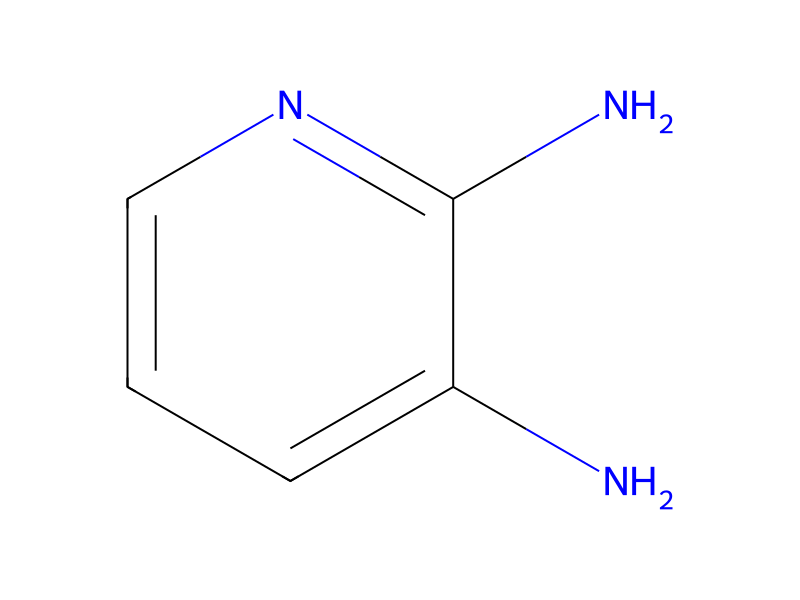
2,3-Diaminopyridine → 2,3-Bis(4-methylphenyl)pyrido[2,3-b]pyrazine
Reaction equation

[C:1]1([CH3:18])[CH:6]=[CH:5][C:4]([C:7](=O)[C:8]([C:10]2[CH:15]=[CH:14][C:13]([CH3:16])=[CH:12][CH:11]=2)=O)=[CH:3][CH:2]=1.[N:19]1[CH:24]=[CH:23][CH:22]=[C:21]([NH2:25])[C:20]=1[NH2:26]>CCO.CC(O)=O>[C:1]1([CH3:18])[CH:6]=[CH:5][C:4]([C:7]2[N:25]=[C:21]3[CH:22]=[CH:23][CH:24]=[N:19][C:20]3=[N:26][C:8]=2[C:10]2[CH:15]=[CH:14][C:13]([CH3:16])=[CH:12][CH:11]=2)=[CH:3][CH:2]=1Participants
5
Reactant 2

Product 1

Reagents, catalysts & solvents 2


Conditions
- Temperature
- 85 °C
Procedure
A solution of 1,2-di-p-tolylethane-1,2-dione (commercially available)(175 g, 733 mmol) and pyridine-2,3-diamine (80 g, 733 mmol) in EtOH (1609 ml) and AcOH (179 ml) was heated to reflux (bath at 85° C.) for 1.5 h. The mixture was allowed to cool and concentrated in vacuo. The crude material was dissolved in DCM (500 ml) and filtered through silica to remove baseline impurities. The silica was washed with EtOAc (2 L). The combined filtrate layers were concentrated in vacuo to give a brown solid. The material was triturated in 1:1 TBME/heptane (300 ml). The solid was removed by filtration and washed with 1:1 TBME/heptane (200 ml) before drying at RT over 2 days to afford the titled compound as an AcOH salt (1 eq).
Workup
- temperatureto cool
- concentrationconcentrated in vacuo
- dissolutionThe crude material was dissolved in DCM (500 ml)
- filtrationfiltered through silica
- customto remove baseline impurities
- washThe silica was washed with EtOAc (2 L)
- concentrationThe combined filtrate layers were concentrated in vacuo
- customto give a brown solid
- customThe material was triturated in 1:1 TBME/heptane (300 ml)
- customThe solid was removed by filtration
- washwashed with 1:1 TBME/heptane (200 ml)
- custombefore drying at RT over 2 days
Sources & evidence
- ORD record
- ord-e41118a318044a98b5bee03da3ec6d38
- Source dataset
- uspto-grants-2015_08
- Patent number
- US09115129B2
Reaction notes
Loading…