Diisopropylethylamine → HCID 178522267, compound
Reaction equation

[Cl:1][C:2]1[CH:24]=[CH:23][C:22]([C:25]2[C:30]([F:31])=[CH:29][CH:28]=[CH:27][N:26]=2)=[CH:21][C:3]=1[C:4]([NH:6][C:7]1[N:11](C2C=CC=CC=2)[N:10]=[C:9]([C:18]([OH:20])=O)[CH:8]=1)=[O:5].C(N([CH:38]([CH3:40])[CH3:39])CC)(C)C.C[Si](C)(C)CCOC[N:47]1[CH:51]=[C:50]([CH2:52][CH2:53][NH2:54])[N:49]=[N:48]1.C[Si](C)(C)CCOCN1N=[C:66]([CH2:68]CN)[CH:65]=N1.C[Si](C)(C)CCOCN1C(CCN)=CN=N1.CN(C(ON1N=NC2C=CC=NC1=2)=[N+](C)C)C.F[P-](F)(F)(F)(F)F>CN(C)C=O>[NH:47]1[CH:51]=[C:50]([CH2:52][CH2:53][NH:54][C:18]([C:9]2[N:10]([C:39]3[CH:38]=[CH:40][CH:68]=[CH:66][CH:65]=3)[N:11]=[C:7]([NH:6][C:4](=[O:5])[C:3]3[CH:21]=[C:22]([C:25]4[C:30]([F:31])=[CH:29][CH:28]=[CH:27][N:26]=4)[CH:23]=[CH:24][C:2]=3[Cl:1])[CH:8]=2)=[O:20])[N:49]=[N:48]1Participants
Reactant 6
 HCID 81531Diisopropylethylamine
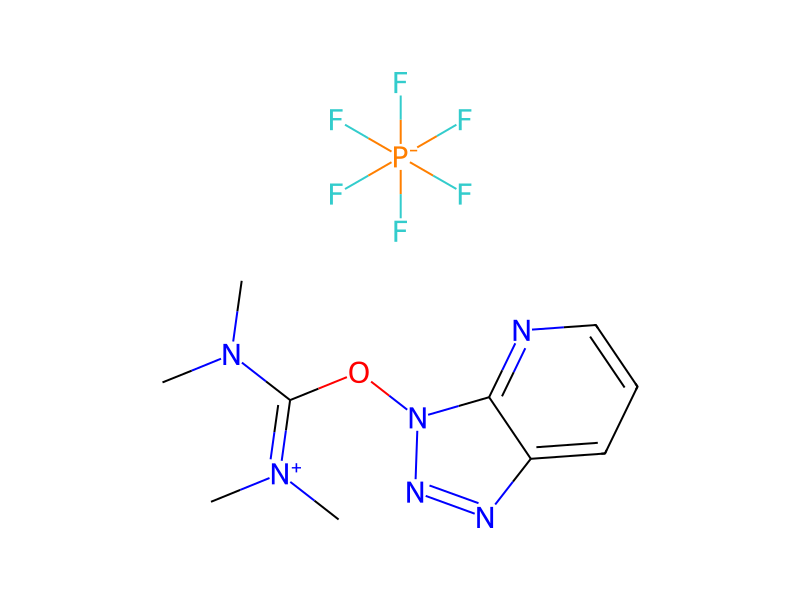 HCID 9886157Methanaminium, N-((dimethylamino)(3H-1,2,3-triazolo(4,5-b)pyridin-3-yloxy)methylene)-N-methyl-, hexafluorophosphate(1-) (1:1)
 HCID 1184971095-(2-chloro-5-(3-fluoropyridin-2-yl)benzamido)-1-phenyl-1H-pyrazole-3-carboxylic acid
 HCID 1234089391-[[2-(Trimethylsilyl)ethoxy]methyl]-1h-1,2,3-triazole-5-ethanamine
 HCID 1239803412-[[2-(Trimethylsilyl)ethoxy]methyl]-2h-1,2,3-triazole-4-ethanamine
 HCID 1254810821-[[2-(Trimethylsilyl)ethoxy]methyl]-1h-1,2,3-triazole-4-ethanamine
Product 1

Reagents, catalysts & solvents 1

Procedure
To a solution of 5-(2-chloro-5-(3-fluoropyridin-2-yl)benzamido)-1-phenyl-1H-pyrazole-3-carboxylic acid (Example 105, 250 mg, 0.57 mmol) and diisopropylethylamine (350 μL, 2.0 mmol)) in dimethylformamide (5 mL) was added a mixture of 2-(1-((2-(trimethylsilyl)ethoxy)methyl)-1H-1,2,3-triazol-4-yl)ethanamine and 2-(2-((2-(trimethylsilyl)ethoxy)methyl)-2H-1,2,3-triazol-4-yl)ethanamine and 2-(1-((2-(trimethylsilyl)ethoxy)methyl)-1H-1,2,3-triazol-5-yl)ethanamine (Preparation 65, 210 mg, 0.84 mmol). The mixture was stirred for 5 minutes before the addition of HATU (220 mg, 0.57 mmol). The reaction was stirred at room temperature for 18 hours and concentrated in vacuo. The residue was partitioned between EtOAc (80 mL) and dilute aqueous sodium hydrogen carbonate solution (80 mL) with saturated aqueous sodium chloride solution (10 mL). The organic layer was collected, dried over anhydrous sodium sulphate and concentrated in vacuo. The residue was dissolved in DCM (20 mL) and treated with TFA (20 mL) with stirring at room temperature for 18 hours. After concentration in vacuo, the residue was partitioned between DCM (80 mL) with MeOH (4 mL) and dilute aqueous sodium hydrogen carbonate solution (50 mL). The organic layer was collected, dried over sodium sulphate and concentrated in vacuo. The residue was purified using silica gel column chromatography eluting with 95:5:0.5 to 90.10:1 DCM:MeOH:NH3 followed by dissolving in hot MeCN (15 mL). The solution was cooled and decanted to afford a residue that was azeotroped with toluene and water to afford the title compound (31 mg, quant.).
Workup
- concentrationconcentrated in vacuo
- customThe residue was partitioned between EtOAc (80 mL) and dilute aqueous sodium hydrogen carbonate solution (80 mL) with saturated aqueous sodium chloride solution (10 mL)
- customThe organic layer was collected
- dry with materialdried over anhydrous sodium sulphate
- concentrationconcentrated in vacuo
- dissolutionThe residue was dissolved in DCM (20 mL)
- additiontreated with TFA (20 mL)
- stirringwith stirring at room temperature for 18 hours
- concentrationAfter concentration in vacuo
- customthe residue was partitioned between DCM (80 mL) with MeOH (4 mL) and dilute aqueous sodium hydrogen carbonate solution (50 mL)
- customThe organic layer was collected
- dry with materialdried over sodium sulphate
- concentrationconcentrated in vacuo
- customThe residue was purified
- washeluting with 95:5:0.5 to 90.10:1 DCM
- dissolutionby dissolving in hot MeCN (15 mL)
- temperatureThe solution was cooled
- customdecanted
- customto afford a residue that
- customwas azeotroped with toluene and water
Sources & evidence
- ORD record
- ord-c4b26ffcff084ba08fa521faa1208343
- Source dataset
- uspto-grants-2016_05
- Patent number
- US09328096B2
Reaction notes
Loading…