Boron tribromide → 1-Ethyl-5-fluoro-6,7-dihydroxy-4-oxo-1,4-dihydroquinoline-3-carboxylic acid
Reaction equation
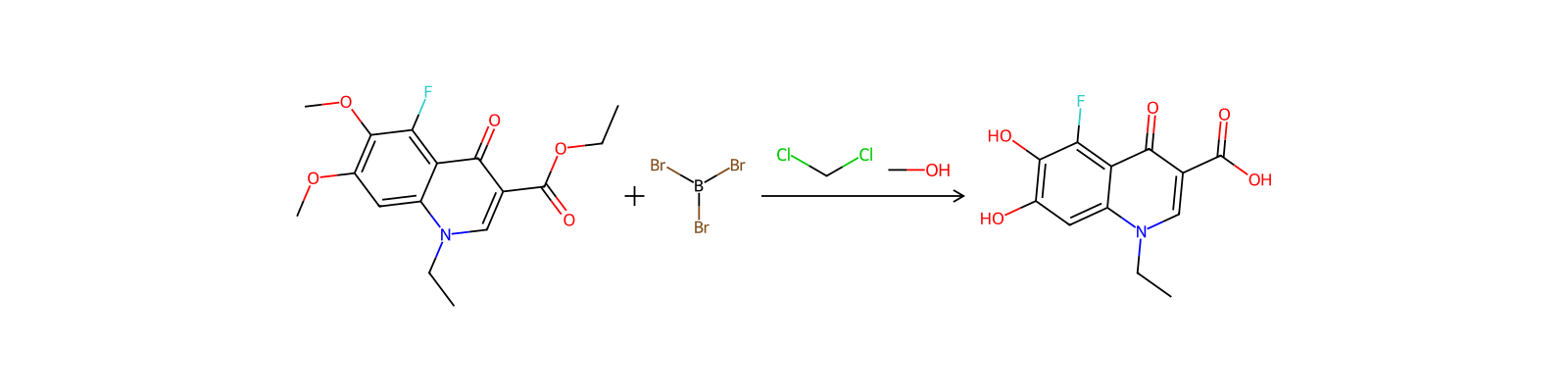
[CH2:1]([N:3]1[C:12]2[C:7](=[C:8]([F:17])[C:9]([O:15]C)=[C:10]([O:13]C)[CH:11]=2)[C:6](=[O:18])[C:5]([C:19]([O:21]CC)=[O:20])=[CH:4]1)[CH3:2].B(Br)(Br)Br>ClCCl.CO>[CH2:1]([N:3]1[C:12]2[C:7](=[C:8]([F:17])[C:9]([OH:15])=[C:10]([OH:13])[CH:11]=2)[C:6](=[O:18])[C:5]([C:19]([OH:21])=[O:20])=[CH:4]1)[CH3:2]Participants
5
Reactant 2


Product 1

Reagents, catalysts & solvents 2


Procedure
To a solution of ethyl 1-ethyl-5-fluoro-6,7-dimethoxy-4-oxo-1,4-dihydroquinoline-3-carboxylate (65 g, 201 mmol) in Dichloromethane (DCM) (300 mL) was added BBr3 (95 mL, 1005 mmol) at −78° C. The mixture was allowed to warm up to rt, and stirred at 25° C. overnight. LCMS indicated completion of the reaction. The mixture was diluted with MeOH and concentrated to dryness. The same process was repeated several times to afford 1-ethyl-5-fluoro-6,7-dihydroxy-4-oxo-1,4-dihydroquinoline-3-carboxylic acid (48 g, 180 mmol, 89% yield) as yellow solid. The crude product was a mixture of acid and small amount of methyl ester, which was used in next step reaction without further purification. LCMS: (M+H)+: 268.0.
Workup
- customcompletion of the reaction
- concentrationconcentrated to dryness
Sources & evidence
- ORD record
- ord-358ece69e597467884ff95c032a09e4f
- Source dataset
- uspto-grants-2016_05
- Patent number
- US09340556B2
Reaction notes
Loading…