HuagongsheHuagongshe Chemistry Print Report · For research reference only
HRID 525938Generated: October 28, 2026
Diisobutylaluminum hydride → HCID 86732807, compound
https://huagongshe.com/reaction/525938
Participants
| Role | Name | HCID | Charge |
|---|
| Reactant | Diisobutylaluminum hydride | HCID 14487 | — |
| Reactant | Isobutyl chloroformate | HCID 62365 | — |
| Reactant | HCID 86732805 | HCID 86732805 | — |
| Solvent | Toluene | HCID 1140 | — |
| Solvent | Tetrahydrofuran | HCID 8028 | — |
| Product | HCID 86732807 | HCID 86732807 | 59.1% |
Reaction Steps
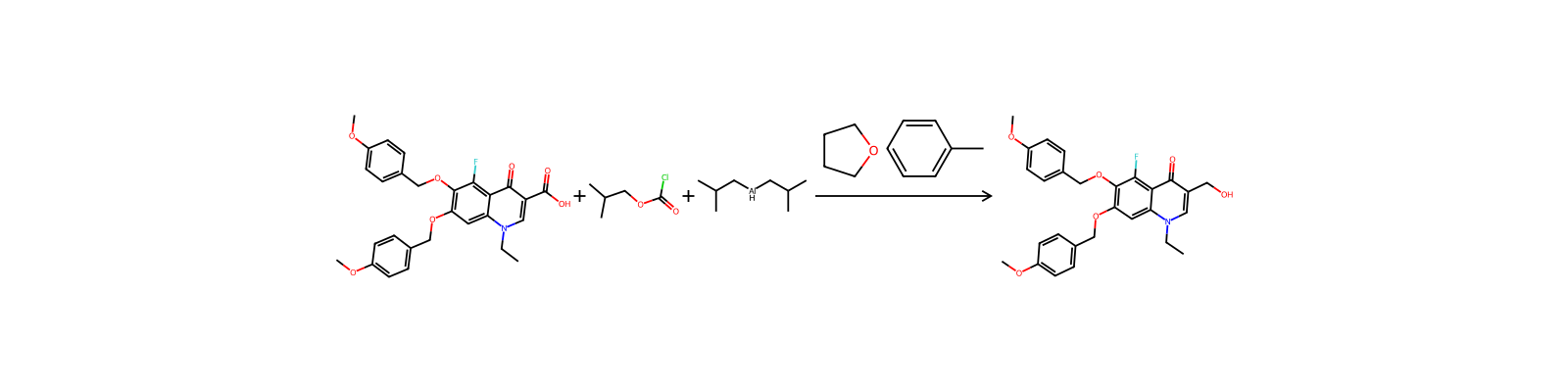
To a suspension of 1-ethyl-5-fluoro-6,7-bis((4-methoxybenzyl)oxy)-4-oxo-1,4-dihydroquinoline-3-carboxylic acid (20 g, 39.4 mmol) in Tetrahydrofuran (THF) (100 mL) was added TEA (6.04 mL, 43.3 mmol) and isobutyl chloroformate (5.69 mL, 43.3 mmol). The resulting mixture was stirred at r.t. for 1 h. Then the mixture was cooled down to −78° C. and a solution of DIBAL-H (52.5 mL, 79 mmol) in toluene (1.5 M) was added. The mixture was stirred at the same temperature for 2 h, LCMS indicated completion of the reaction. The reaction was quenched with sat. NH4Cl (aq.), and was warmed up to r.t., concentrated, diluted with sat. NH4Cl and extracted with dichloromethane. The organic mixture was filtered through Celite to remove gummy precipitate. The combined organic solution was then washed with brine, dried over sodium sulfate, filtered and the filtrate was concentrated in vacuo to afford 1-ethyl-5-fluoro-3-(hydroxymethyl)-6,7-bis((4-methoxybenzyl)oxy)quinolin-4(1H)-one (11.5 g, 23.30 mmol, 59.1% yield) as a yellow solid, which was used in the next oxidation step without further purification. LCMS: (M+H)+: 494.2
Provenance & Evidence
| DOI | 10.6084/m9.figshare.5104873.v1 |
|---|
| Patent number | US09340556B2 |
|---|
| Source dataset | uspto-grants-2016_05 |
|---|
| ORD ID | ord-a2a76a9947054169b1d17296bcb3eae8 |
|---|
| Source note | uspto-grants-2016_05 |
|---|