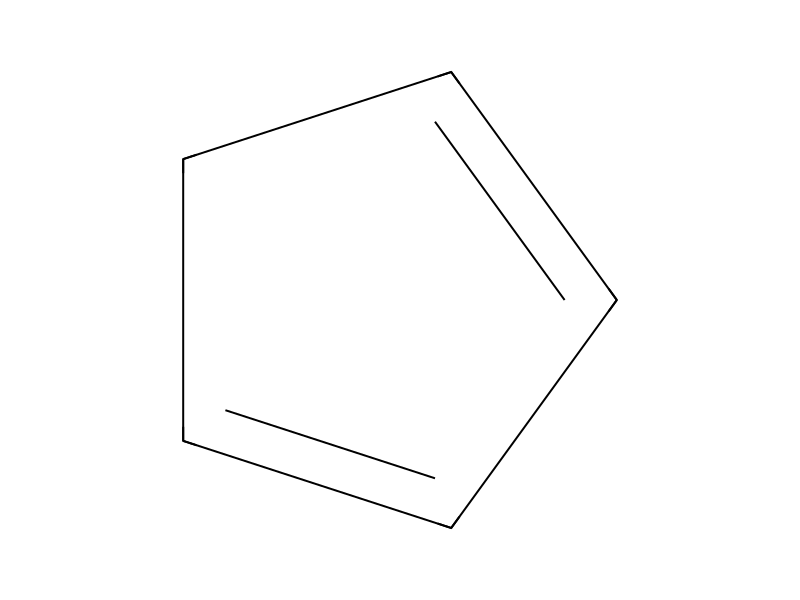
Cyclopentadiene → Trimethylolpropane triacrylate
Reaction equation

[C:1]([OH:5])(=[O:4])[CH:2]=[CH2:3].[C:6]([OH:10])(=[O:9])[CH:7]=[CH2:8].[C:11]([OH:15])(=[O:14])[CH:12]=[CH2:13].[CH2:16]([C:18]([CH2:23]O)([CH2:21]O)[CH2:19][CH3:20])O.C1CC=CC=1>>[CH3:20][CH2:19][C:18]([CH2:23][O:14][C:11]([CH:12]=[CH2:13])=[O:15])([CH2:21][O:9][C:6]([CH:7]=[CH2:8])=[O:10])[CH2:16][O:4][C:1]([CH:2]=[CH2:3])=[O:5]Participants


Procedure
Trimethylolpropane triacrylate (177.8 g, 0.60 mole) and cyclopentadiene (112.0 g, 1.8 mole) were stirred at 25-40° C. for 21 hours to obtain Diels-Alder adduct of TMPTA-CPD. The obtained TMPTA-CPD (165.0 g, 0.33 mole), fumaric acid (38.3 g, 0.33 mole) and THQ (0.07 g) were heated to 190° C. in 3 hours under nitrogen and held for 12 hours to obtain a oligomeric acid with an acid number of 55 mg KOH/g, glycidyl methacrylate (28.4 g, 0.20 mole) and benzyltriethylammonium chloride (0.15 g) were heated to 110-120° C. and held for 2 hours to obtain an acrylic ester with an acid number of 22. The resulting acrylic ester was dissolved in styrene with 0.04 g of THQ to obtain a resin with 30% styrene. The resin solution has a viscosity of 430 cps, gel time 9.0 min, cure time 12.0 min, and peak exotherm 210° C.
Sources & evidence
- ORD record
- ord-69db23c3a8dc404e8e4bba422b46f497
- Source dataset
- uspto-grants-2016_05
- Patent number
- US09353213B2
Reaction notes
Loading…