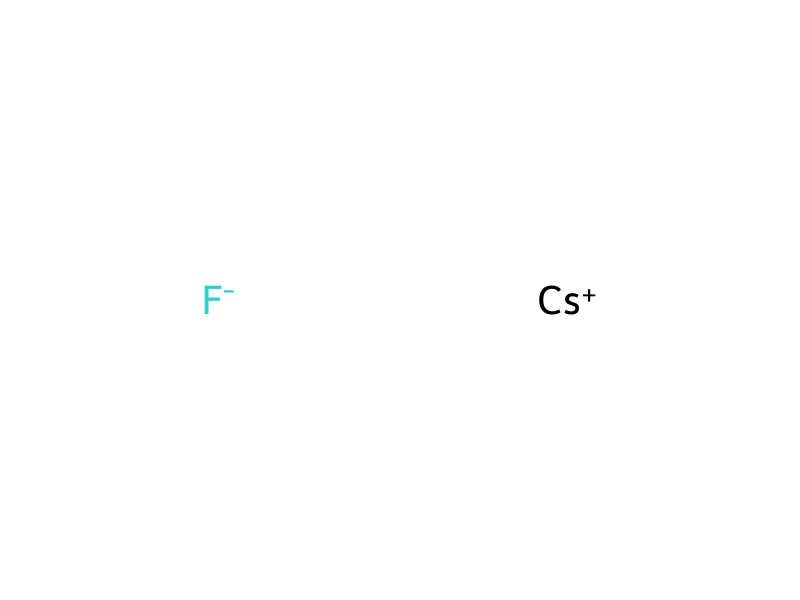
Cesium fluoride → Methyl 3-chloro-4-(2,4-difluorophenyl)quinoline-6-carboxylate
Reaction equation

Br[C:2]1[C:11]2[C:6](=[CH:7][CH:8]=[C:9]([C:12]([O:14][CH3:15])=[O:13])[CH:10]=2)[N:5]=[CH:4][C:3]=1[Cl:16].[F:17][C:18]1[CH:23]=[C:22]([F:24])[CH:21]=[CH:20][C:19]=1OB(O)O.[F-].[Cs+].O1CCOCC1>[Pd].C1(P(C2C=CC=CC=2)[C-]2C=CC=C2)C=CC=CC=1.[C-]1(P(C2C=CC=CC=2)C2C=CC=CC=2)C=CC=C1.[Fe+2].O>[Cl:16][C:3]1[CH:4]=[N:5][C:6]2[C:11]([C:2]=1[C:21]1[CH:20]=[CH:19][C:18]([F:17])=[CH:23][C:22]=1[F:24])=[CH:10][C:9]([C:12]([O:14][CH3:15])=[O:13])=[CH:8][CH:7]=2Participants
7
Reactant 4



Product 1

Reagents, catalysts & solvents 2


Conditions
- Temperature
- 100 °C
Procedure
Under argon gas atmosphere, a mixture of methyl 4-bromo-3-chloroquinoline-6-carboxylate (130 mg), 2,4-difluorophenylboric acid (137 mg), a 1,1′-bis(diphenylphosphino)ferrocene palladium (H) dichloride/dichloromethane complex (177 mg), cesium fluoride (197 mg), 1,4-dioxane (8 mL), and water (2 mL) was heated under stirring in an oil bath at 100° C. for one day. The reaction mixture was returned to room temperature, and water was added, and extracted with ethyl acetate. The organic layer was concentrated under reduced pressure, and the resulting residue was purified under silica gel column chromatography (hexane/ethyl acetate) to obtain methyl 3-chloro-4-(2,4-difluorophenyl)quinoline-6-carboxylate (100 mg).
Workup
- customwas returned to room temperature
- extractionextracted with ethyl acetate
- concentrationThe organic layer was concentrated under reduced pressure
- customthe resulting residue was purified under silica gel column chromatography (hexane/ethyl acetate)
Sources & evidence
- ORD record
- ord-777a251daad84671af204320cfc450bb
- Source dataset
- uspto-grants-2014_10
- Patent number
- US08853242B2
Reaction notes
Loading…