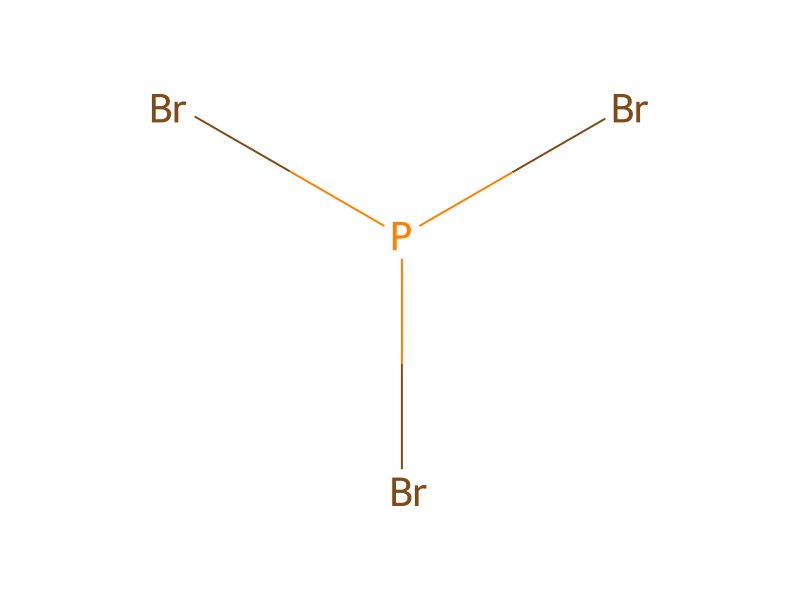
Phosphorus tribromide → 4-(bromomethyl)-3-iodo-1-isopropyl-1H-pyrazole
Reaction equation

[I:1][C:2]1[C:6]([CH2:7]O)=[CH:5][N:4]([CH:9]([CH3:11])[CH3:10])[N:3]=1.P(Br)(Br)[Br:13]>ClCCl>[Br:13][CH2:7][C:6]1[C:2]([I:1])=[N:3][N:4]([CH:9]([CH3:11])[CH3:10])[CH:5]=1Participants
Reactant 2

Product 1

Reagents, catalysts & solvents 1

Conditions
- Temperature
- 0 °C
Procedure
A solution of (3-iodo-1-isopropyl-1H-pyrazol-4-yl)methanol (0.63 g, 2.37 mmol) in 20 mL dichloromethane was cooled to 0° C. Phosphorus(III)bromide (0.67 mL, 7.10 mmol) was added to the solution and the mixture was stirred 30 minutes at 0° C., 1 hour at room temperature, and then quenched with 50 mL water and stirred 15 minutes at room temperature. The mixture was treated with saturated aqueous sodium bicarbonate and extracted with ethyl acetate (2×50 mL). The combined organic layers were washed with brine (50 mL), dried over sodium sulfate, filtered and concentrated. The residue was purified by flash chromatography (10-80% ethyl acetate/heptanes, 25 g silica gel) to yield 400 mg of 4-(bromomethyl)-3-iodo-1-isopropyl-1H-pyrazole as a colorless solid. +APCI (M+H) 329.0; 1H NMR (400 MHz, CDCl3, δ): 7.42 (s, 1H), 4.47 (spt, J=6.7 Hz, 1H), 4.35 (s, 2H), 1.50 (d, J=6.6 Hz, 6H).
Workup
- customquenched with 50 mL water
- stirringstirred 15 minutes at room temperature
- additionThe mixture was treated with saturated aqueous sodium bicarbonate
- extractionextracted with ethyl acetate (2×50 mL)
- washThe combined organic layers were washed with brine (50 mL)
- dry with materialdried over sodium sulfate
- filtrationfiltered
- concentrationconcentrated
- customThe residue was purified by flash chromatography (10-80% ethyl acetate/heptanes, 25 g silica gel)
Sources & evidence
- ORD record
- ord-909eeabf85f54a7185eb6b0c2d9f8942
- Source dataset
- uspto-grants-2014_10
- Patent number
- US08859773B2
Reaction notes
Loading…