3,4-Dimethoxyaniline → 2-Bromo-4,5-dimethoxyaniline
Reaction equation

[NH2:1][C:2]1[CH:3]=[C:4]([O:10][CH3:11])[C:5]([O:8][CH3:9])=[CH:6][CH:7]=1.[Br-:12].[Br-].[Br-].C([N+](CCCC)(CCCC)CCCC)CCC.C([N+](CCCC)(CCCC)CCCC)CCC.C([N+](CCCC)(CCCC)CCCC)CCC>ClCCl.CO>[Br:12][C:7]1[CH:6]=[C:5]([O:8][CH3:9])[C:4]([O:10][CH3:11])=[CH:3][C:2]=1[NH2:1]Participants
5
Reactant 2
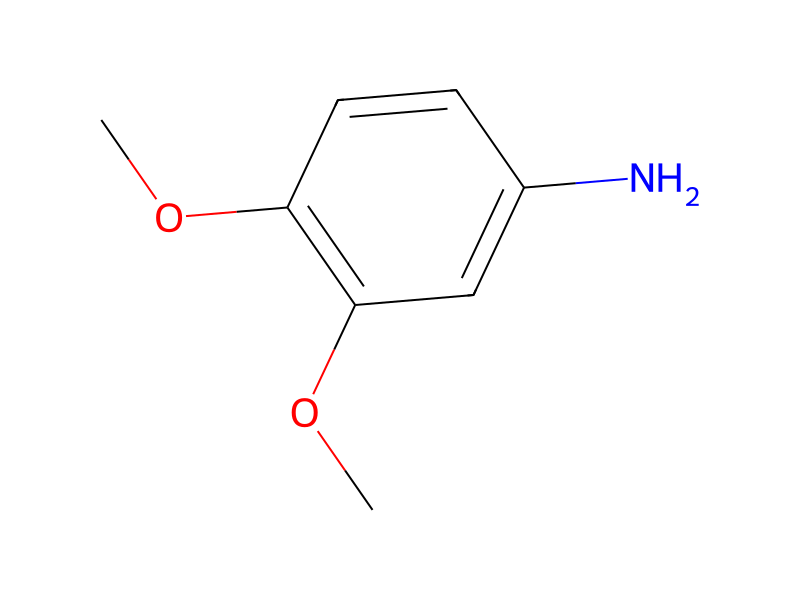

Product 1

Reagents, catalysts & solvents 2


Procedure
Following the procedure reported in JACS 1996, 118, 1028-1030, 4-aminoveratrole (3.06 g, 20.0 mmol) was dissolved in a mixture of dichloromethane (80 ml) and methanol (40 ml) at room temperature. Tetrabutylammonium tribromide (1.15 eq, 11.09 g) was added and the mixture was allowed to stir for 20 minutes. The mixture was extracted with saturated aqueous sodium sulfite solution. The organic layer was washed with water, dried over anhydrous sodium sulfate, filtered and concentrated in vacuo. The residue was purified by flash chromatography (gradient 10:1 to 7:3 hexanes/ethyl acetate) to give 2-bromo-4,5-dimethoxy-aniline 1.403 g (30%) of a yellow oil.
Workup
- extractionThe mixture was extracted with saturated aqueous sodium sulfite solution
- washThe organic layer was washed with water
- dry with materialdried over anhydrous sodium sulfate
- filtrationfiltered
- concentrationconcentrated in vacuo
- customThe residue was purified by flash chromatography (gradient 10:1 to 7:3 hexanes/ethyl acetate)
Sources & evidence
- ORD record
- ord-ae1e8f9458de4fd48af66ccc1414429a
- Source dataset
- uspto-grants-2014_10
- Patent number
- US08871760B2
Reaction notes
Loading…