Isopropanol → Isopropyl 4,5,6-trifluoropicolinate
Reaction equation

ClC1C(Cl)=C(Cl)N=C(C(Cl)=O)C=1.[F-].[Cs+].C1OCCOCCOCCOCCOCCOC1.[CH3:33][CH:34]([OH:36])[CH3:35].C(N(CC)CC)C.[F:44][C:45]1[C:50]([F:51])=[C:49]([F:52])[N:48]=[C:47]([C:53](F)=[O:54])[CH:46]=1>C(#N)C>[F:44][C:45]1[C:50]([F:51])=[C:49]([F:52])[N:48]=[C:47]([C:53]([O:36][CH:34]([CH3:35])[CH3:33])=[O:54])[CH:46]=1Participants
Reactant 6




Product 1

Reagents, catalysts & solvents 1

Procedure
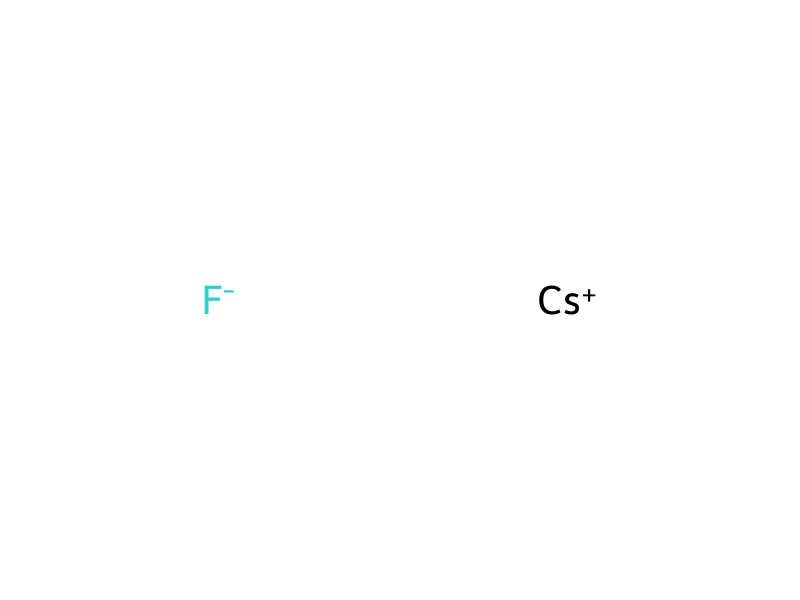
Into a 250 mL 3-necked flask equipped with a mechanical stirrer and a condenser was added 4,5,6-trichloropicolinoyl chloride (23.3 g, 95 mmol), CsF (72.2 g, 475 mmol), 18-crown-6 (2.5 g, 9.5 mmol) and anhydrous acetonitrile (150 mL). The reaction was blanketed with nitrogen, and the mixture was heated at reflux with vigorous stirring for 22 hours. A sample was taken and analyzed by GC. The results showed that the reaction was not complete, therefore additional CsF (14.43 g, 95 mmol) was added, and the mixture was heated at reflux for an additional 24 hours at which time the reaction was deemed complete. Then 6.28 g (104.5 mmol) of anhydrous 2-propanol and 9.61 g (95 mmol) of anhydrous triethyl amine were added to the flask dropwise at 6° C. The mixture was stirred for 5-6 hours at room temperature. The reaction was stopped when GC showed no starting 4,5,6-trifluoropicolinoyl fluoride was left in the mixture. The salts were removed by filtration and washed with some acetonitrile. After removing acetonitrile with a rotary evaporator, the wet product paste was re-dissolved in ethyl ether. The mixture was washed with water and dried over MgSO4. Most of ethyl ether was removed with a rotary evaporator. The concentrated crude product mixture in ethyl ether was filtered through a bed of silica gel, and eluted with some ethyl ether. After stripping away the solvent on a rotary evaporator, 17.52 g (84% yield, 94% HPLC purity) of isopropyl 4,5,6-trifluoropicolinate was obtained 1H NMR (CDCl3, 300 MHz) δ 7.90 (ddd, 1H, J=9 Hz, 5 Hz, 1 Hz), 5.30 (m, 1H, J=6 Hz), 1.41 (d, 6H, J=6 Hz); 13C NMR (CDCl3, 75 MHz, 1H decoupled) δ 161.2 (d, J=4 Hz), 157.2 (ddd, J=265 Hz, 9 Hz, 6 Hz), 152.1 (ddd, J=241 Hz, 12 Hz, 5 Hz), 140.9 (m), 136.8 (ddd, J=269 Hz, 30 Hz, 13 Hz), 113.6 (m), 70.4 (s), 21.3 (s).
Workup
- customInto a 250 mL 3-necked flask equipped with a mechanical stirrer and a condenser
- temperaturethe mixture was heated
- temperatureat reflux
- temperaturethe mixture was heated
- temperatureat reflux for an additional 24 hours at which time the reaction
- stirringThe mixture was stirred for 5-6 hours at room temperature
- waitwas left in the mixture
- customThe salts were removed by filtration
- washwashed with some acetonitrile
- customAfter removing acetonitrile
- customwith a rotary evaporator
- dissolutionthe wet product paste was re-dissolved in ethyl ether
- washThe mixture was washed with water
- dry with materialdried over MgSO4
- customMost of ethyl ether was removed with a rotary evaporator
- concentrationThe concentrated crude product mixture in ethyl ether
- filtrationwas filtered through a bed of silica gel
- washeluted with some ethyl ether
- customon a rotary evaporator
Sources & evidence
- ORD record
- ord-d6ddc71849e9400c85e3fc548b502f1d
- Source dataset
- uspto-grants-2014_10
- Patent number
- US08871943B2
Reaction notes
Loading…