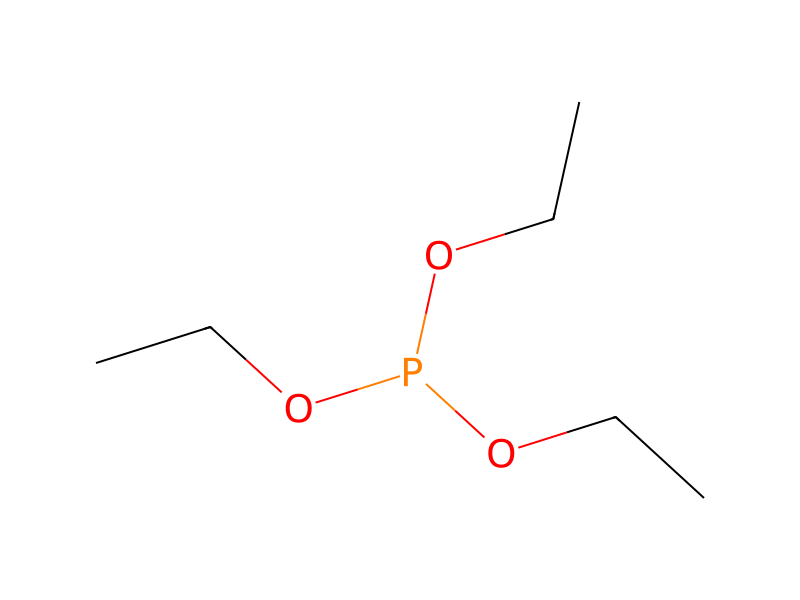
Triethyl phosphite → Ethyl 3-[2-(diethylphosphonopropyl)phenyl]-2-acetamido-2-carboethoxypropanoate
Reaction equation

Br[CH2:2][CH2:3][CH2:4][C:5]1[CH:10]=[CH:9][CH:8]=[CH:7][C:6]=1[CH2:11][C:12]([NH:23][C:24](=[O:26])[CH3:25])([C:18]([O:20][CH2:21][CH3:22])=[O:19])[C:13]([O:15][CH2:16][CH3:17])=[O:14].[CH2:27]([O:29][P:30]([O:34]CC)[O:31][CH2:32][CH3:33])[CH3:28]>>[CH2:27]([O:29][P:30]([CH2:2][CH2:3][CH2:4][C:5]1[CH:10]=[CH:9][CH:8]=[CH:7][C:6]=1[CH2:11][C:12]([NH:23][C:24](=[O:26])[CH3:25])([C:18]([O:20][CH2:21][CH3:22])=[O:19])[C:13]([O:15][CH2:16][CH3:17])=[O:14])([O:31][CH2:32][CH3:33])=[O:34])[CH3:28]Participants
3


Procedure
A solution of 7.5 g (17.5 mmol) of ethyl 3-[2-(3-bromopropyl)phenyl]-2-acetamido-2-carboethoxypropanoate in 20 mL of freshly distilled triethylphosphite was stirred at reflux for 6 h. The excess P(OEt)3 and the volatile by-products were removed from the mixture by distillation under vacuum. The remaining viscous oil was chromatographed on a column of silica gel with ethyl acetate as eluant. The combined fractions were concentrated under reduced pressure to yield 4.2 g (49%) of the product as a viscous yellow oil. IR(neat): 1746, 1680 cm-1 (C=O). 1H NMR(CDCl3) δ 1.1-2.1 (complex m, 19H); 2.4-2.7 (t, 2H); 3.6 (5, 2H); 3.8-4.3 (m, 8H); 6.55 (s, 1H); 6.9-7.2 (m, 4H).
Workup
- temperatureat reflux for 6 h
- customThe excess P(OEt)3 and the volatile by-products were removed from the mixture by distillation under vacuum
- customThe remaining viscous oil was chromatographed on a column of silica gel with ethyl acetate as eluant
- concentrationThe combined fractions were concentrated under reduced pressure
Sources & evidence
- ORD record
- ord-616b2ccb88814facbbe1a8de25379179
- Source dataset
- uspto-grants-1987_04
- Patent number
- US04657899
Reaction notes
Loading…