Hydrochloric Acid → 3-Bromo-4-fluorobenzaldehyde
Reaction equation

[F:1][C:2]1[CH:7]=[CH:6][C:5]([CH3:8])=[CH:4][CH:3]=1.BrBr.FC1C=CC(C(Br)[Br:17])=CC=1.[Cl-].[Al+3].[Cl-].[Cl-].Cl.[OH2:26]>[Cl-].[Zn+2].[Cl-].ClCCCl>[Br:17][C:3]1[CH:4]=[C:5]([CH:6]=[CH:7][C:2]=1[F:1])[CH:8]=[O:26]Participants
Reactant 6


Product 1

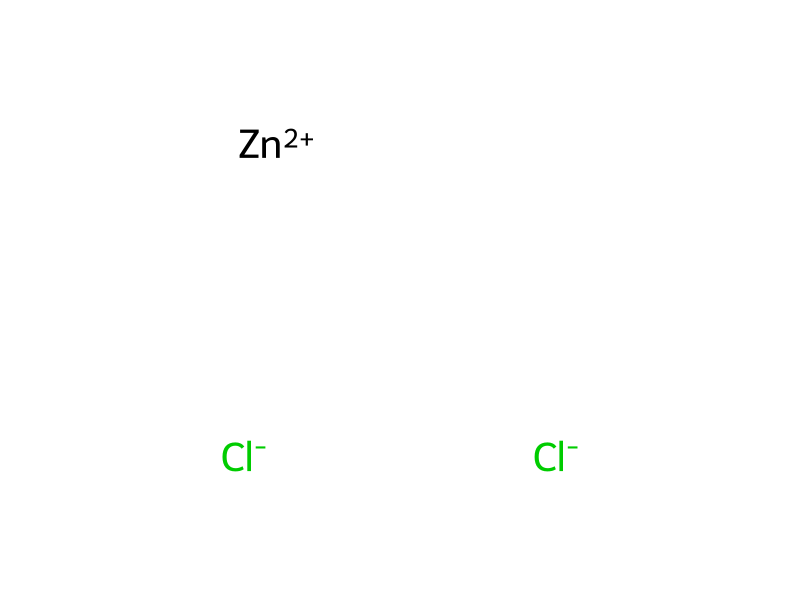
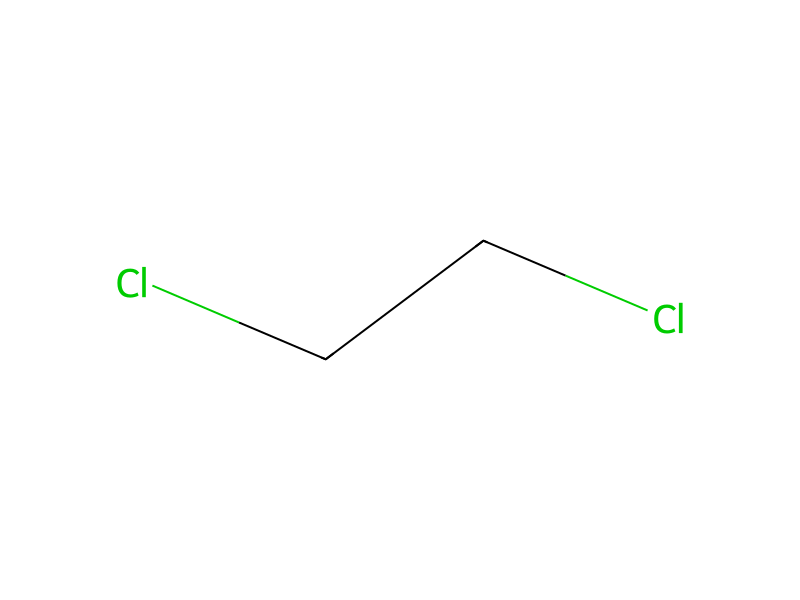
Reagents, catalysts & solvents 2
Conditions
- Temperature
- 110 °C
Procedure
250 g (2.27 mols) of 4-fluorotoluene are added to 1.25 g (7.61 mmols) of α, α'-azoisobutyronitrile and heated to a temperature of 110° C. In the course of 4 hours, 725 g (4.54 mols) of bromine are added dropwise while raising the temperature of the reaction mixture to 145° C. 1.25 g (9.17 mmols) of zinc chloride are added to the mixture substantially consisting of 4-fluorobenzalbromide, and subsequently 40 g of water are added within 6 hours. After cooling to a temperature of 80° C. and addition of 1,160 g (930 ml) of 1,2-dichloroethane, the mixture is cooled to 150° C. Subsequently, 500 g of aluminum chloride are added portionwise to the mixture without exceeding a temperature of 20° C. Then, the mixture is heated to 40° C., and during 6 hours 382 g (2.39 mols) of bromine are added dropwise; afterwards, stirring of the mixture is continued for 16 hours at a temperature of 40° C. The reaction mixture is slowly poured onto a mixture of 2,400 g of ice and 105 g of concentrated hydrochloric acid, and thoroughly stirred for 5 minutes. The organic phase of the mixture is separated and washed twice with water and 10% aqueous sodium carbonate solution, respectively, and once with water. After evaporation of the 1,2-dichloroethane the product is fractionated. There are obtained 210 g (45%, relative to 4-fluorotoluene) of 3-bromo-4-fluorobenzaldehyde with a boiling range of 92° to 98° C. (at a pressure of 17 mbar) and a purity degree of more than 99%.
Workup
- temperaturewhile raising the temperature of the reaction mixture to 145° C
- additionare added within 6 hours
- temperaturethe mixture is cooled to 150° C
- customa temperature of 20° C
- temperatureThen, the mixture is heated to 40° C.
- stirringthoroughly stirred for 5 minutes
- customThe organic phase of the mixture is separated
- washwashed twice with water and 10% aqueous sodium carbonate solution
- customAfter evaporation of the 1,2-dichloroethane the product
Sources & evidence
- ORD record
- ord-841775025f1943179ade33237a48c236
- Source dataset
- uspto-grants-1984_05
- Patent number
- US04446075
Reaction notes
Loading…