3-Chloro-4-fluoroaniline → 4-[(3-Chloro-4-fluorophenyl)amino]-6-nitro-3-quinolinecarbonitrile
Reaction equation

Cl[C:2]1[C:11]2[C:6](=[CH:7][CH:8]=[C:9]([N+:12]([O-:14])=[O:13])[CH:10]=2)[N:5]=[CH:4][C:3]=1[C:15]#[N:16].[Cl:17][C:18]1[CH:19]=[C:20]([CH:22]=[CH:23][C:24]=1[F:25])[NH2:21]>C(O)C>[Cl:17][C:18]1[CH:19]=[C:20]([NH:21][C:2]2[C:11]3[C:6](=[CH:7][CH:8]=[C:9]([N+:12]([O-:14])=[O:13])[CH:10]=3)[N:5]=[CH:4][C:3]=2[C:15]#[N:16])[CH:22]=[CH:23][C:24]=1[F:25]Participants
4
Reactant 2
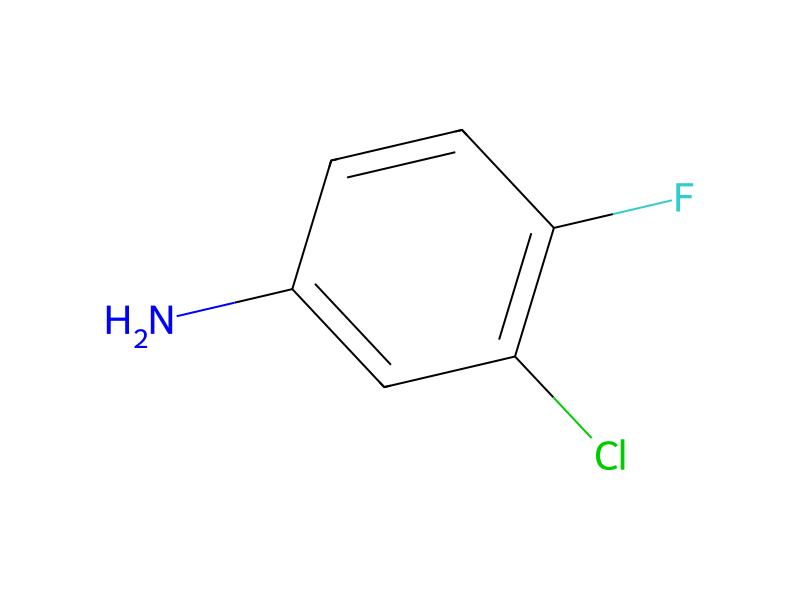

Product 1

Reagents, catalysts & solvents 1

Procedure
A mixture of 5.00 g (21.5 mmol) 4-chloro-6-nitro-quinoline-3-carbonitrile, 200 ml ethanol, and 3.75 g (25.8 mmol) 3-chloro-4-fluoroaniline was heated to reflux under N2. Removed heat at 3½ hours and added a solution of saturated sodium bicarbonate until mixture was basic. Stripped solvents and azeotroped with ethanol. Slurried residue with hexane, collected solids, washed with water and dried in vacuo. Dissolved solids in 250 ml boiling ethyl acetate, stirred with Darco, and filtered. Stripped solvent and dried in vacuo, giving 6.036 g of yellow solid: mass spectrum (electrospray m/e): M+H=343.1, 345.1.
Workup
- temperaturewas heated
- temperatureto reflux under N2
- customRemoved
- temperatureheat at 3½ hours
- additionadded a solution of saturated sodium bicarbonate until mixture
- customStripped solvents and azeotroped with ethanol
- customcollected solids
- washwashed with water
- customdried in vacuo
- dissolutionDissolved solids in 250 ml
- filtrationfiltered
- customStripped solvent and dried in vacuo
Sources & evidence
- ORD record
- ord-23b3eed8c9004e408f964b741def0d03
- Source dataset
- uspto-grants-2011_05
- Patent number
- USRE042376E1
Reaction notes
Loading…