O-Phenylenediamine → 2,3-Bis(4-bromophenyl)quinoxaline
Reaction equation

[C:1]1([NH2:8])[CH:6]=[CH:5][CH:4]=[CH:3][C:2]=1[NH2:7].[Br:9][C:10]1[CH:15]=[CH:14][C:13]([C:16](=O)[C:17]([C:19]2[CH:24]=[CH:23][C:22]([Br:25])=[CH:21][CH:20]=2)=O)=[CH:12][CH:11]=1>C(Cl)(Cl)Cl>[Br:9][C:10]1[CH:11]=[CH:12][C:13]([C:16]2[C:17]([C:19]3[CH:20]=[CH:21][C:22]([Br:25])=[CH:23][CH:24]=3)=[N:8][C:1]3[C:2](=[CH:3][CH:4]=[CH:5][CH:6]=3)[N:7]=2)=[CH:14][CH:15]=1Participants
4
Reactant 2
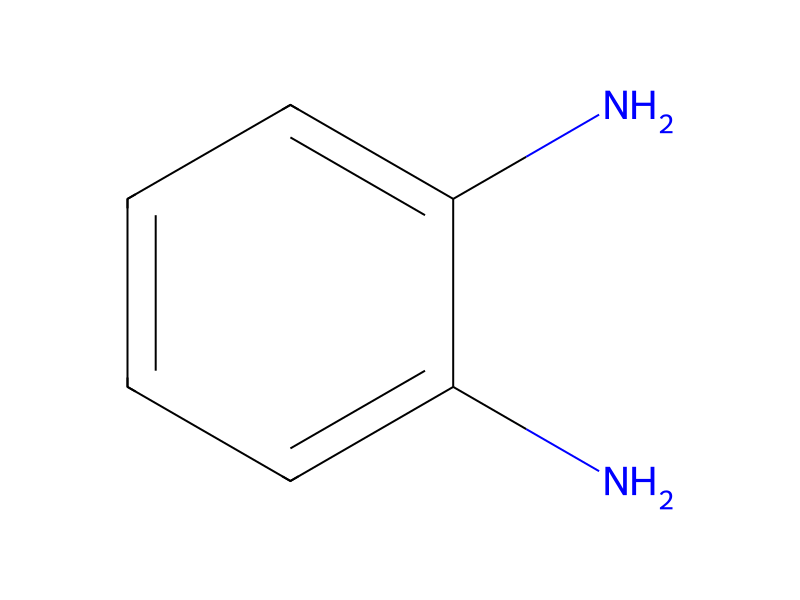

Product 1

Reagents, catalysts & solvents 1

Procedure
1,2-phenylenediamine (6.8 g) and 1,2-bis-(4-bromo-phenyl)-ethane-1,2-dione (22.1 g) were dissolved in 350 ml of chloroform and heated to reflux for three hours. The reaction solution was washed with 1N-hydrochloric acid, water, and a saturated aqueous solution of sodium chloride and dried with magnesium sulfate. Then the reaction was concentrated under reduced pressure to give 24.4 g of 2,3-bis(4-bromophenyl)quinoxaline as a white solid. The synthesis scheme and the structural formula are shown in a following formula (15).
Workup
- temperatureheated
- temperatureto reflux for three hours
- washThe reaction solution was washed with 1N-hydrochloric acid, water
- dry with materiala saturated aqueous solution of sodium chloride and dried with magnesium sulfate
- concentrationThen the reaction was concentrated under reduced pressure
Sources & evidence
- ORD record
- ord-e39abd524b05442585d51c6456f06ece
- Source dataset
- uspto-grants-2011_05
- Patent number
- US07951470B2
Reaction notes
Loading…