O-Phenylenediamine → 2,3-Bis(4-bromophenyl)quinoxaline
Reaction equation

[Br:1][C:2]1[CH:7]=[CH:6][C:5]([C:8]([C:10]([C:12]2[CH:17]=[CH:16][C:15]([Br:18])=[CH:14][CH:13]=2)=O)=O)=[CH:4][CH:3]=1.[C:19]1([NH2:26])[CH:24]=[CH:23][CH:22]=[CH:21][C:20]=1[NH2:25]>C(Cl)(Cl)Cl>[Br:1][C:2]1[CH:7]=[CH:6][C:5]([C:8]2[C:10]([C:12]3[CH:17]=[CH:16][C:15]([Br:18])=[CH:14][CH:13]=3)=[N:26][C:19]3[C:20](=[CH:21][CH:22]=[CH:23][CH:24]=3)[N:25]=2)=[CH:4][CH:3]=1Participants
4
Reactant 2
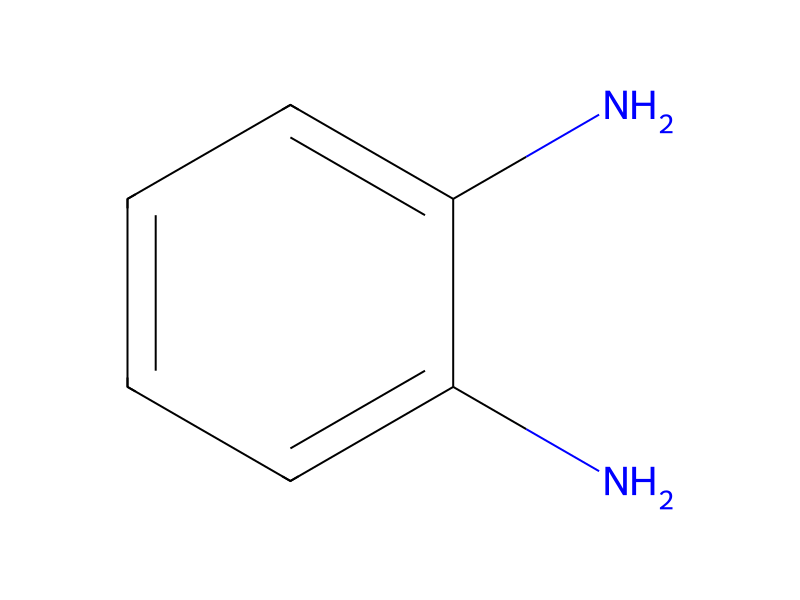

Product 1

Reagents, catalysts & solvents 1

Conditions
- Temperature
- 80 °C
Procedure
A chloroform solution (200 mL) of 30.0 g (81.5 mmol) of 4,4′-dibromobenzil and 9.00 g (83.2 mmol) of o-phenylenediamine was heated and refluxed at 80° C. for 3 hours under nitrogen atmosphere. The reaction solution was washed with water after being cooled to room temperature. An aqueous layer was extracted with chloroform. This extracted aqueous layer and an organic layer were put together and washed with a saturated saline solution. The organic layer was dried over magnesium sulfate and filtered. The filtrate was condensed to obtain 33 g (yield: 92%) of objective 2,3-bis(4-bromophenyl)quinoxaline as a white solid. Synthetic scheme of Step 1 is shown in the following (d-1).
Workup
- washThe reaction solution was washed with water
- temperatureafter being cooled to room temperature
- extractionAn aqueous layer was extracted with chloroform
- washwashed with a saturated saline solution
- dry with materialThe organic layer was dried over magnesium sulfate
- filtrationfiltered
- customcondensed
Sources & evidence
- ORD record
- ord-fa8f6dad7ad047a4b8e62d003cb4b1e2
- Source dataset
- uspto-grants-2011_11
- Patent number
- US08048540B2
Reaction notes
Loading…