Acetic Acid → N-{[1,6-Diethyl-4-(tetrahydro-2H-pyran-4-ylamino)-1H-pyrazolo[3,4-b]pyridin-5-yl]methyl}-N'-[(6-fluoro-3'-{[(3R)-3-methyl-1-piperazinyl]methyl}-3-biphenylyl)methyl]-1,3-benzenedicarboxamide
Reaction equation

[CH2:1]([N:3]1[C:7]2=[N:8][C:9]([CH2:48][CH3:49])=[C:10]([CH2:19][NH:20][C:21]([C:23]3[CH:28]=[CH:27][CH:26]=[C:25]([C:29]([NH:31][CH2:32][C:33]4[CH:34]=[C:35]([C:40]5[CH:45]=[CH:44][CH:43]=[C:42]([CH:46]=O)[CH:41]=5)[C:36]([F:39])=[CH:37][CH:38]=4)=[O:30])[CH:24]=3)=[O:22])[C:11]([NH:12][CH:13]3[CH2:18][CH2:17][O:16][CH2:15][CH2:14]3)=[C:6]2[CH:5]=[N:4]1)[CH3:2].[CH3:50][C@@H:51]1[CH2:56][NH:55][CH2:54][CH2:53][N:52]1C(OC(C)(C)C)=O.C(O[BH-](OC(=O)C)OC(=O)C)(=O)C.[Na+].CC(O)=O>ClCCCl>[CH2:1]([N:3]1[C:7]2=[N:8][C:9]([CH2:48][CH3:49])=[C:10]([CH2:19][NH:20][C:21]([C:23]3[CH:28]=[CH:27][CH:26]=[C:25]([C:29]([NH:31][CH2:32][C:33]4[CH:34]=[C:35]([C:40]5[CH:45]=[CH:44][CH:43]=[C:42]([CH2:46][N:55]6[CH2:54][CH2:53][NH:52][C@H:51]([CH3:50])[CH2:56]6)[CH:41]=5)[C:36]([F:39])=[CH:37][CH:38]=4)=[O:30])[CH:24]=3)=[O:22])[C:11]([NH:12][CH:13]3[CH2:14][CH2:15][O:16][CH2:17][CH2:18]3)=[C:6]2[CH:5]=[N:4]1)[CH3:2]Participants
Reactant 4


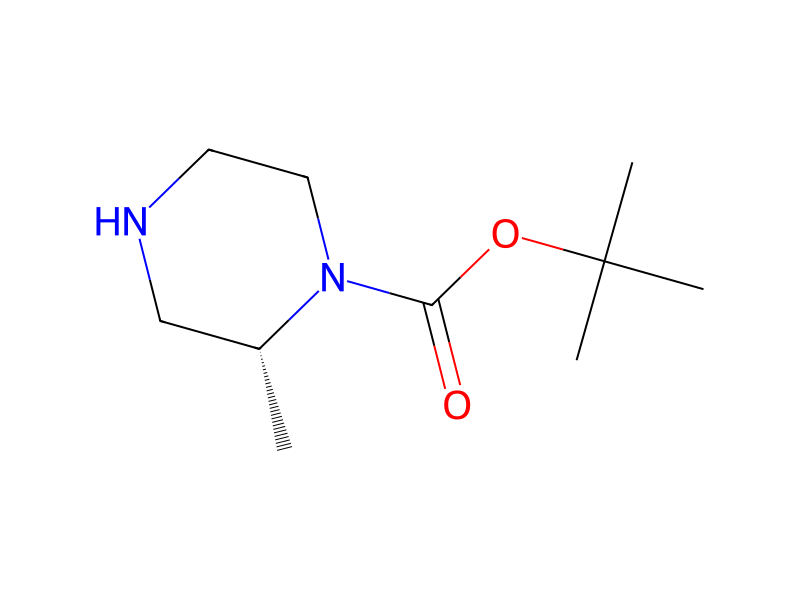

Product 1

Reagents, catalysts & solvents 1

Procedure
A mixture of N-{[1,6-diethyl-4-(tetrahydro-2H-pyran-4-ylamino)-1H-pyrazolo[3,4-b]pyridin-5-yl]methyl}-N′-[(6-fluoro-3′-formyl-3-biphenylyl)methyl]-1,3-benzenedicarboxamide (100 mg, 0.000152 mol) in 1,2-dichloroethane (4 mL) with 1,1-dimethylethyl (2R)-2-methyl-1-piperazinecarboxylate (48 mg, 0.00024 mol) and sodium triacetoxyborohydride (68 mg, 0.00032 mol) and AcOH (12 μL) was placed on an oscillating shaker overnight at room temperature. The reaction was quenched with sat. aq. NaHCO3, then extracted with 1,2-dichloroethane (2×). Combined organic extracts were washed with sat. aq. NaCl and dried (Na2SO4) and concentrated to a residue. The crude product was taken up in 1,2-dichloroethane (10 mL) containing 25% TFA and allowed to stand at room temperature for 1.5 h. LC-MS showed the reaction to be complete and the solution stripped to dryness. Purification was carried out on Gilson HPLC instrument with acetonitrile-water (0.1% TFA) gradient; C18-RP Column. Fractions containing the clean desired product were combined; diluted with EtOAc; washed with sat. aq. NaHCO3; and the aq. phase was back-extracted with EtOAc. Combined organic extracts were washed with sat. aq. NaCl and dried (Na2SO4) and concentrated to a residue. It was taken up in a small amount of 1,2-dichloroethane and transferred to a vial and pumped down to afford the title compound as an ivory colored solid [62.1 mg (53%)]. LC-MS m/z 747.3 (M+H)+.
Workup
- customwas placed on an oscillating shaker overnight at room temperature
- customThe reaction was quenched with sat. aq. NaHCO3
- extractionextracted with 1,2-dichloroethane (2×)
- washCombined organic extracts were washed with sat. aq. NaCl
- dry with materialdried (Na2SO4)
- concentrationconcentrated to a residue
- additioncontaining 25% TFA
- customthe reaction
- customPurification
- additionFractions containing the clean desired product
- additiondiluted with EtOAc
- washwashed with sat. aq. NaHCO3
- extractionand the aq. phase was back-extracted with EtOAc
- washCombined organic extracts were washed with sat. aq. NaCl
- dry with materialdried (Na2SO4)
- concentrationconcentrated to a residue
Sources & evidence
- ORD record
- ord-ad49e1b9134b4f0b92ce3a0906c5374a
- Source dataset
- uspto-grants-2011_11
- Patent number
- US08067408B2
Reaction notes
Loading…