4-Aminobenzoic Acid → Benzoic acid, 4-amino-, 1,1-dimethylethyl ester
Reaction equation

[NH2:1][C:2]1[CH:10]=[CH:9][C:5]([C:6]([OH:8])=[O:7])=[CH:4][CH:3]=1>S(Cl)(Cl)=O>[NH2:1][C:2]1[CH:10]=[CH:9][C:5]([C:6]([O:8][C:5]([CH3:9])([CH3:6])[CH3:4])=[O:7])=[CH:4][CH:3]=1Participants
Reactant 1
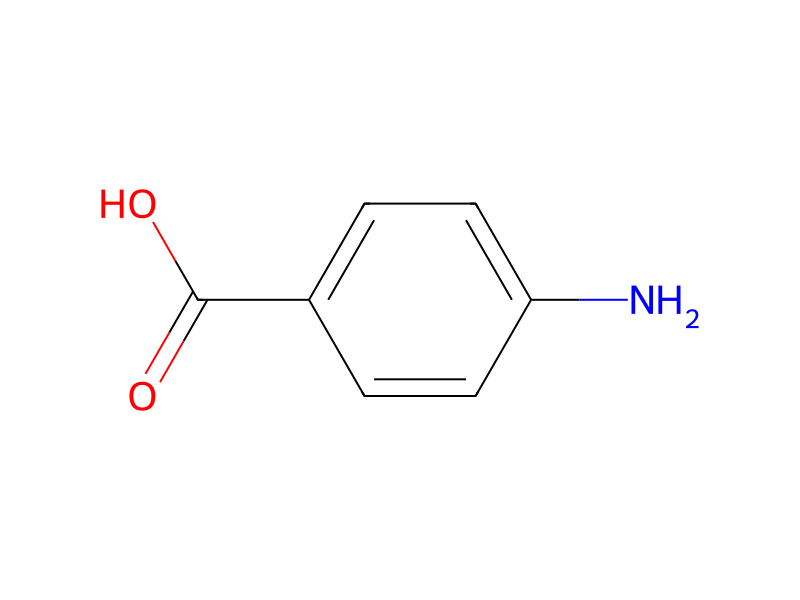
Product 1

Reagents, catalysts & solvents 1

Procedure
4-Aminobenzoic acid (5.0 g) was suspended in thionyl chloride (50 ml) and heated to a gentle reflux. After two hours the solution went completely clear, and so the reaction was allowed to cool and the thionyl chloride was removed under reduced pressure, the last traces by azeotrope with dichloromethane (3×50 ml). The resulting acid chloride was dissolved in more dichloromethane (50 ml) and a solution of t-butanol (15 ml) in dichloromethane (15 ml) was added to the stirred solution which was cooled in an ice bath. A solid white precipitate was formed--the hydrochloride salt of the title compound. This was isolated by evaporation of the dichloromethane, followed by suspension of the solid in ethyl acetate (100 ml) and filtration. The material was suspended in 10% aqueous sodium hydrogencarbonate solution (100 ml) and extracted into dichloromethane (3×100 ml). The organic layer was dried, filtered and evaporated to leave a pale cream solid (4.67 g, 66%), m.p. 106°-109° C. (lit. m.p. 109.5° C.) (R. Adams et al (1926) J. Amer. Chem. Soc., 48, 1758), the title compound.
Workup
- temperatureheated to a gentle reflux
- temperatureto cool
- customthe thionyl chloride was removed under reduced pressure
- dissolutionThe resulting acid chloride was dissolved in more dichloromethane (50 ml)
- additiona solution of t-butanol (15 ml) in dichloromethane (15 ml) was added to the stirred solution which
- temperaturewas cooled in an ice bath
- customA solid white precipitate was formed
Sources & evidence
- ORD record
- ord-64c93de919da4f1d9c4220dbad05a38d
- Source dataset
- uspto-grants-1988_03
- Patent number
- US04730050
Reaction notes
Loading…