Hydrochloric Acid → HCID 178429549, 화합물
반응식

N1C=CC(=O)N=1.[Br-].[CH3:8][C:9]1[N:10]([C:18]2[CH:23]=[CH:22][CH:21]=[CH:20][CH:19]=2)[N+:11]2CCC[O:13][C:12]=2[CH:17]=1.CC1(CC(OCC)=O)OCCO1.C1(NN)C=CC=CC=1.C[O-].[Na+].CC1(CC(NNC2C=CC=CC=2)=O)OCCO1.Cl>C1C=CC=CC=1>[OH:13][C:12]1[CH:17]=[C:9]([CH3:8])[N:10]([C:18]2[CH:19]=[CH:20][CH:21]=[CH:22][CH:23]=2)[N:11]=1참가 물질
반응물 7
 HCID 313Hydrochloric Acid
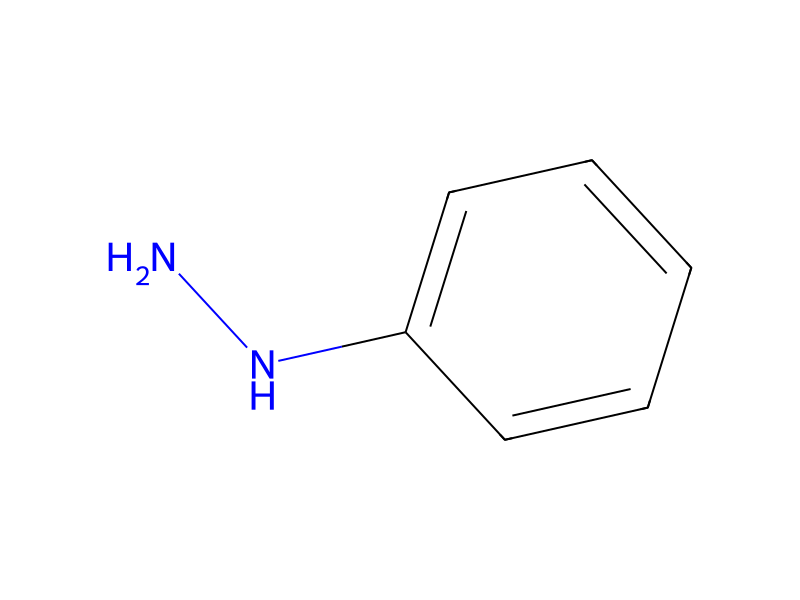 HCID 7516Phenylhydrazine
 HCID 80865Ethyl acetoacetate ethyleneglycol ketal
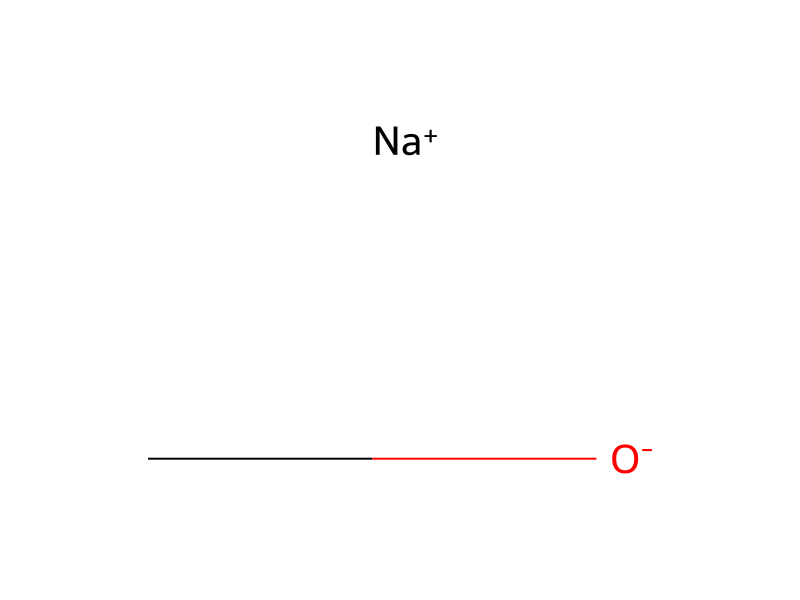 HCID 10942334Sodium Methoxide
 HCID 11513733Pyrazolone
 HCID 128096062-(2-methyl-1,3-dioxolan-2-yl)-N'-phenylacetohydrazide
 HCID 667153532-methyl-1-phenyl-6,7-dihydro-1H,5H-pyrazolo(5,1-b)(1,3)oxazin-8-ium bromide
생성물 1

시약·촉매·용매 1

반응 조건
- 온도
- 90 °C
실험 절차
Ueda et al. (Synthesis of pyrazolone derivatives. XLII. Synthesis and analgesic activity of 2-methyl-1-phenyl-6,7-dihydro-1H,5H-pyrazolo[5,1-b][1,3]oxazin-8-ium bromide. Yakugaku Zasshi (1982), 102(8), 743-7) proposes in Chart I of page 744 and in the last two paragraphs on page 745, the reaction of an ethyl 2-(2-methyl-1,3-dioxolan-2-yl)acetate with phenylhydrazine in the presence of sodium methoxide as a base and benzene as a solvent, thereby obtaining 2-(2-methyl-1,3-dioxolan-2-yl)-N′-phenylacetohydrazide, which is further cyclised after treatment with hydrochloric acid 10% and heating on a water bath at 90° C., to obtain 3-hydroxy-5-methyl-1-phenylpyrazole. However, this method presents the disadvantage that both sodium methoxide and benzene are unsuitable for industrial upscaling, in particular, sodium methoxide is a dangerous and highly toxic reagent and benzene is carcinogenic and therefore unsuitable for use in large quantities. Moreover, the reaction devised by Ueda et al. presents a non-optimal yield for 2-(2-methyl-1,3-dioxolan-2-yl)-N′-phenylacetohydrazide (30%). Most importantly, when the inventors tried to reproduce said reaction with similar conditions and a naphthylhydrazine was used instead of the phenylhydrazine (see Example 26 below), they were unsuccessful in preparing the desired final intermediate in optimal isomeric purity. Adversely, an isomeric mixture (80:20) of 5-methyl-1-(naphthalen-2-yl)-1H-pyrazol-3-ol (desired isomer) and 3-methyl-1-(naphthalen-2-yl)-1H-pyrazol-5-ol (non-desired isomer) was obtained. This process does not avoid the distal nitrogen of the hydrazine from reacting with the ketone carbonyl of the ketoacetate, thereby generating by-products that make this route not interesting for industrial production.
출처 및 근거
- ORD 기록
- ord-8c26754118434ca287d159b8d5d5dacd
- 출처 데이터셋
- uspto-grants-2015_05
- 특허 번호
- US09035070B2
반응 노트
불러오는 중…