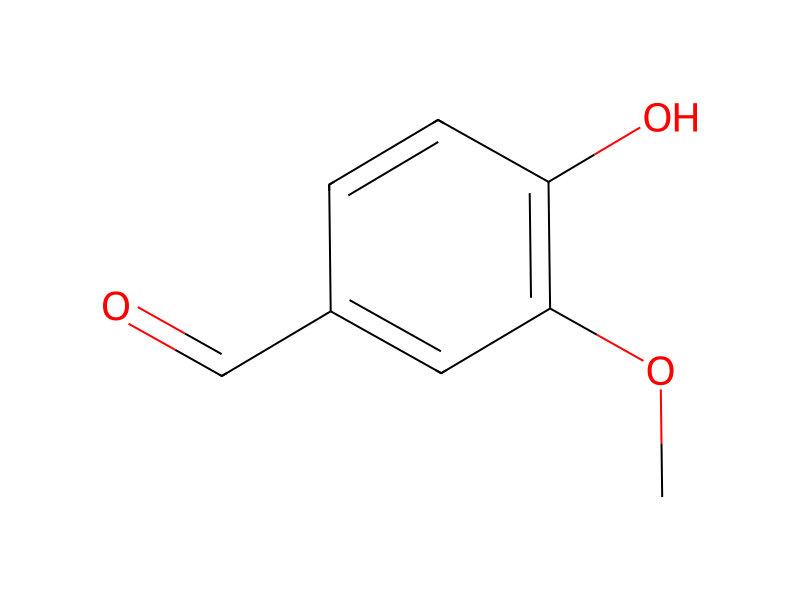
Vanillin → 4,4'-[[1-(Hydroxymethyl)-1,2-ethanediyl]bis(oxy)]bis[3-methoxybenzaldehyde]
Reaction equation

[O:1]=[CH:2][C:3]1[CH:11]=[CH:10][C:8]([OH:9])=[C:5]([O:6][CH3:7])[CH:4]=1.Br[CH:13]([CH2:16]Br)[CH2:14][OH:15]>>[OH:15][CH2:14][CH:13]([O:9][C:8]1[CH:10]=[CH:11][C:3]([CH:2]=[O:1])=[CH:4][C:5]=1[O:6][CH3:7])[CH2:16][O:9][C:8]1[CH:10]=[CH:11][C:3]([CH:2]=[O:1])=[CH:4][C:5]=1[O:6][CH3:7]Participants
3


Procedure
Vanillin (30.4 g, 0.2 m) is reacted with 2,3-dibromopropanol (21.8 g, 0.1 mol) according to the procedure employed in Example 41 to obtain 25.86 g of 4,4'-[[1-(hydroxymethyl)-1,2-ethanediyl]bis(oxy)]bis[3-methoxybenzaldehyde]. This intermediate (3.60 g, 0.01 m) is reacted with ethyl cyanoacetate as described in Example 41 to yield 4.3 g of product which mas spectroscopy indicated had the structure: ##STR32## When dissolved in methylene chloride, the product has an absorption maximum (λmax) at 361 nm.
Sources & evidence
- ORD record
- ord-684b784c5a044e139ca6c4125f7cba2d
- Source dataset
- uspto-grants-1988_06
- Patent number
- US04749774
Reaction notes
Loading…