Ethanol → HCID 10399169, compound
Reaction equation
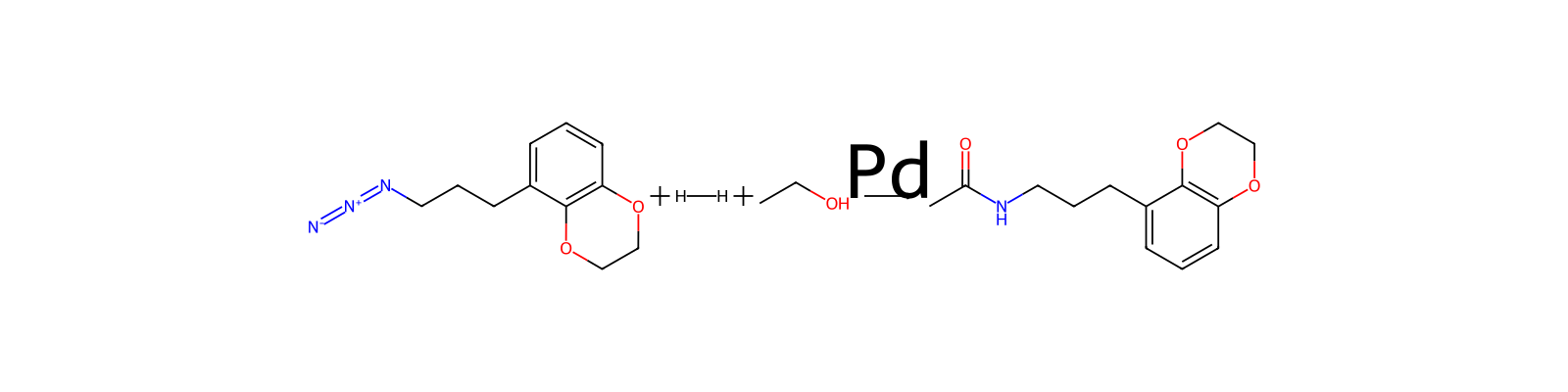
[N:1]([CH2:4][CH2:5][CH2:6][C:7]1[C:16]2[O:15][CH2:14][CH2:13][O:12][C:11]=2[CH:10]=[CH:9][CH:8]=1)=[N+]=[N-].[H][H].[CH2:19]([OH:21])[CH3:20]>[Pd]>[O:12]1[C:11]2[CH:10]=[CH:9][CH:8]=[C:7]([CH2:6][CH2:5][CH2:4][NH:1][C:19](=[O:21])[CH3:20])[C:16]=2[O:15][CH2:14][CH2:13]1Participants
5
Reactant 3



Product 1

Reagents, catalysts & solvents 1

Procedure
The amine is first of all synthesised by catalytic hydrogenation of the compound obtained in Step A. The latter (900 mg; 4.1 mmol) is dissolved with ethanol (15 ml) in the reactor of a Paar apparatus. After the addition of the catalyst, in this case 10% palladium on carbon (90 mg; 10% by weight), stirring is maintained for 4 hours at room temperature at a hydrogen pressure of 45 psi. The reaction mixture is filtered and then concentrated under reduced pressure, and the amine is recovered in the form of a colourless oil. The latter is of the correct purity according to thin-layer chromatography and will thus be acetylated directly under the conditions of Step C of Example 1. Pale yellow oil.
Workup
- additionAfter the addition of the catalyst
- filtrationThe reaction mixture is filtered
- concentrationconcentrated under reduced pressure
- customthe amine is recovered in the form of a colourless oil
Sources & evidence
- ORD record
- ord-fca5ac5b1de54443865bb97b947cfe7e
- Source dataset
- uspto-grants-1999_07
- Patent number
- US05919814
Reaction notes
Loading…