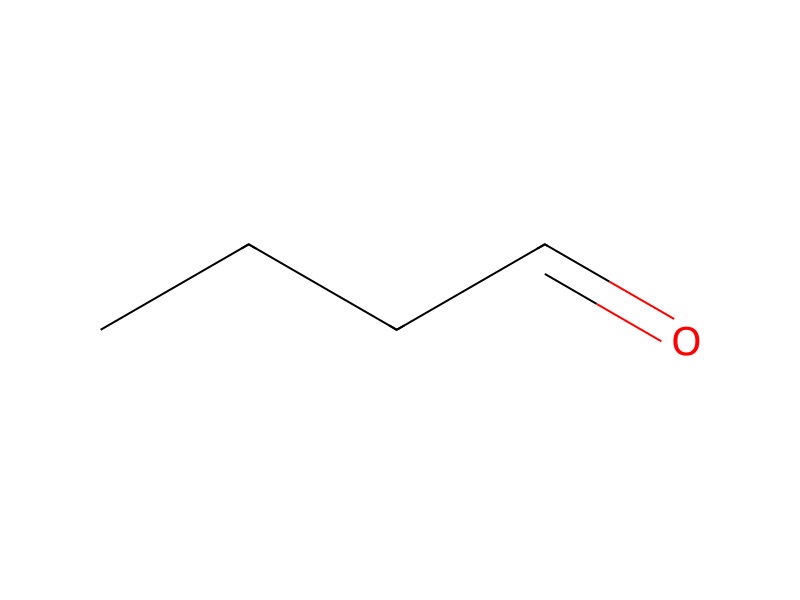
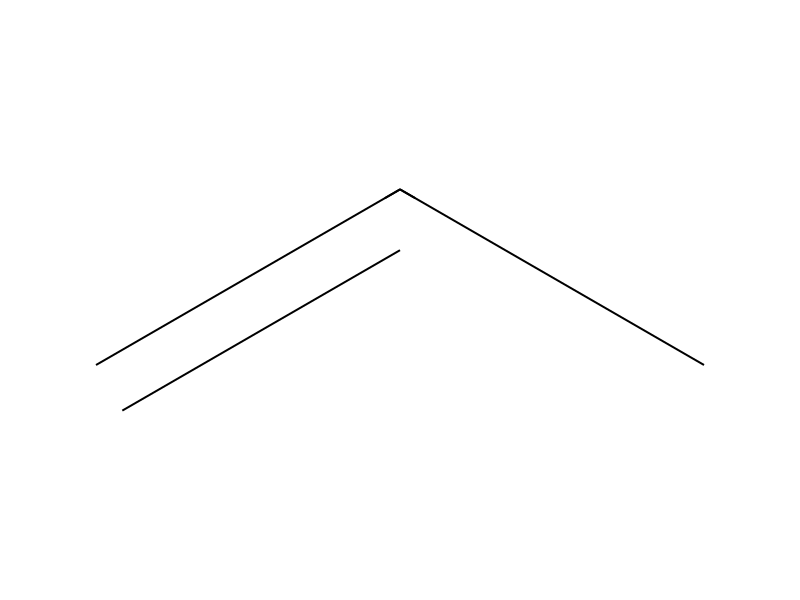
Butanal → Butyl ether
Reaction equation

[CH:1](=[O:5])[CH2:2][CH2:3][CH3:4].C=CC.[C]=O.[H][H].[CH2:13](O)[CH2:14][CH2:15][CH3:16]>>[CH2:1]([O:5][CH2:13][CH2:14][CH2:15][CH3:16])[CH2:2][CH2:3][CH3:4]Participants




Procedure
It is known to produce n-butanol by the hydrogenation of the n-butyraldehyde obtained, for example, by the hydroformylation of propylene by reaction with carbon monoxide and hydrogen. However, in order to be suitable for various applications, e.g., as a solvent for fats, waxes and resins, and in the manufacture of rayon, detergents and various butyl compounds, the n-butanol must have a high degree of purity including a specified low level of various impurities produced by the hydroformylation and hydrogenation reactions. To deal with this problem, the crude n-butanol produced by the hydrogenation reaction must be purified, generally by fractional distillation. One of the impurities intended to be removed by the distillation is di-n-butylether (DBE) which has an atmospheric boiling point of 142° C., but in the absence of water forms a binary azeotrope with n-butanol having an atmospheric boiling point of about 117.6° C. This is very close to the boiling point of pure n-butanol of about 117.2° C., making it difficult to separate DBE from n-butanol when water is not present. However in the presence of water, a ternary azeotrope of water, n-butanol and DBE is formed having a boiling point of about 90.6° C. which can be exploited in the separation of DBE from the bulk of the n-butanol product. Other impurities produced during the catalytic hydrogenation of n-butyraldehyde to form n-butanol are so-called "heavy ends," which are relatively high boiling and tend to break down during purification by distillation to form "permanganate time consumers" (PTC's), i.e., certain unsaturated compounds and chromophores such as olefins, aldehydes and ketones, during distillation. The PTC's, like other impurities such as DBE, may also produce an adverse effect on end use applications if present in the n-butanol product, and like DBE, their separation from the n-butanol product is facilitated by the presence of water in the distillation column.
Workup
- customproduced by the hydroformylation and hydrogenation reactions
- distillationmust be purified, generally by fractional distillation
- customto be removed by the distillation
- customThis is very close to the boiling point of pure n-butanol of about 117.2° C.
- customto separate DBE from n-butanol when water
Sources & evidence
- ORD record
- ord-f1123a86ad614636b9140c627506e0b7
- Source dataset
- uspto-grants-1999_07
- Patent number
- US05922921
Reaction notes
Loading…