Trimethylamine → N~2~-Dodecanoyl-L-glutamine
Reaction equation

[C:1](Cl)(=[O:13])[CH2:2][CH2:3][CH2:4][CH2:5][CH2:6][CH2:7][CH2:8][CH2:9][CH2:10][CH2:11][CH3:12].[NH2:15][C@H:16]([C:22]([OH:24])=[O:23])[CH2:17][CH2:18][C:19](=[O:21])[NH2:20].CN(C)C>O1CCOCC1.O>[C:1]([NH:15][C@H:16]([C:22]([OH:24])=[O:23])[CH2:17][CH2:18][C:19](=[O:21])[NH2:20])(=[O:13])[CH2:2][CH2:3][CH2:4][CH2:5][CH2:6][CH2:7][CH2:8][CH2:9][CH2:10][CH2:11][CH3:12]Participants
6
Reactant 3

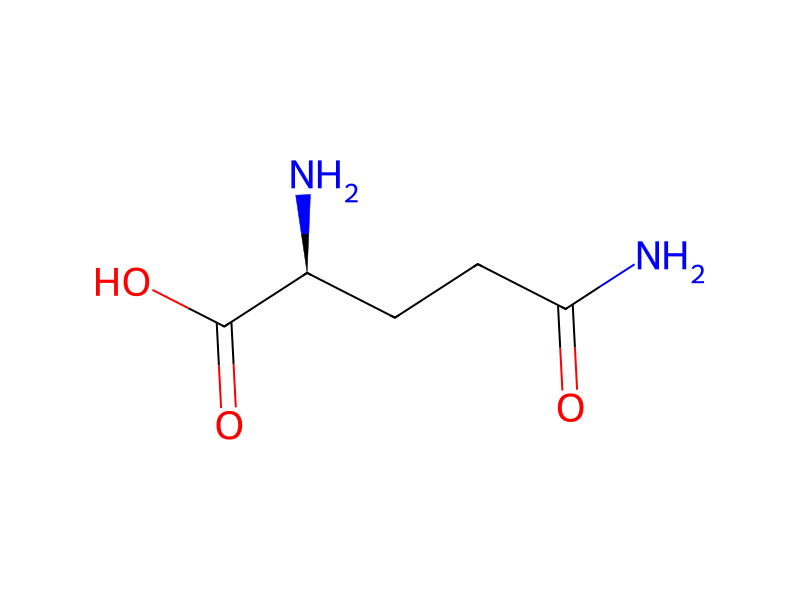

Product 1

Reagents, catalysts & solvents 2


Procedure
9.22 g lauroylchloride dissolved in 46 ml dioxane were slowly added to 6.72 g glutamine and 13.94 g trimethylamine in 92 ml water and 92 ml dioxane, the temperature being 0° C. After stirring at room temperature for 1 hour, the dioxane was evaporated and the remaining solution was acidified to pH 1 with HCl. The crystals were filtered off and recrystallized from acetone and then from methanol: 9.9 g white needles.
Workup
- custombeing 0° C
- customthe dioxane was evaporated
- filtrationThe crystals were filtered off
- customrecrystallized from acetone
Sources & evidence
- ORD record
- ord-ddaca9a67a9e4fcaa805209103cbef1d
- Source dataset
- uspto-grants-1999_07
- Patent number
- US05925339
Reaction notes
Loading…