Perbenzoic acid → Methyl 3-pentadecyloxirane-2-carboxylate
Reaction equation

[C:1]([O:20][CH3:21])(=[O:19])/[CH:2]=[CH:3]/[CH2:4][CH2:5][CH2:6][CH2:7][CH2:8][CH2:9][CH2:10][CH2:11][CH2:12][CH2:13][CH2:14][CH2:15][CH2:16][CH2:17][CH3:18].C1C(C(OO)=[O:29])=CC=CC=1>C(Cl)(Cl)Cl>[O:29]1[CH:3]([CH2:4][CH2:5][CH2:6][CH2:7][CH2:8][CH2:9][CH2:10][CH2:11][CH2:12][CH2:13][CH2:14][CH2:15][CH2:16][CH2:17][CH3:18])[CH:2]1[C:1]([O:20][CH3:21])=[O:19]Participants
Reactant 2
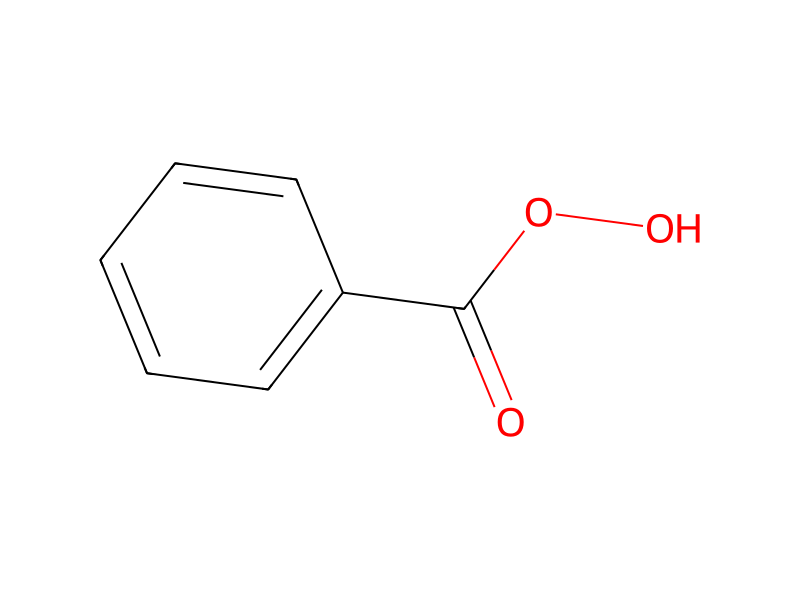

Product 1

Reagents, catalysts & solvents 1

Procedure
For preparation of racemic dihydrosphingosines, K. Sisido, et al., report in J. Org. Chem., Vol. 29, No. 9, pp. 2783-2784 (1964) a process comprising, for example, reacting methyl trans-2-octadecenoate with perbenzoic acid in chloroform to obtain methyl 2,3-epoxyoctadecanoate having formula (V'): ##STR3## whose planar structure is the same as that of the compound represented by formula (V) hereinafter described, hydrolyzing the ester (V'), cyclizing the resulting acid by reaction with benzylamine to obtain 2-benzylamino-3-hydroxyoctadecanoic acid (cyclization yield: 68%), converting the acid to a methyl ester, and reducing the ester in an ether solvent with lithium aluminum hydride (LiAlH4) (reduction yield: 71%). Reduction of such a carboxylic acid as 2-benzylamino-3-hydroxyoctadecanoic acid to an alcohol has generally been carried out by once esterifying the carboxylic acid and using LiAlH4 as a reducing agent as in the above report. However, LiAlH4 is a reagent unsuitable to industrial use because it is not only expensive but difficult to handle on account of reactivity with moisture in air.
Sources & evidence
- ORD record
- ord-42e514f21c334b5c8b0d54c2eb8a9d8a
- Source dataset
- uspto-grants-1999_07
- Patent number
- US05925792
Reaction notes
Loading…