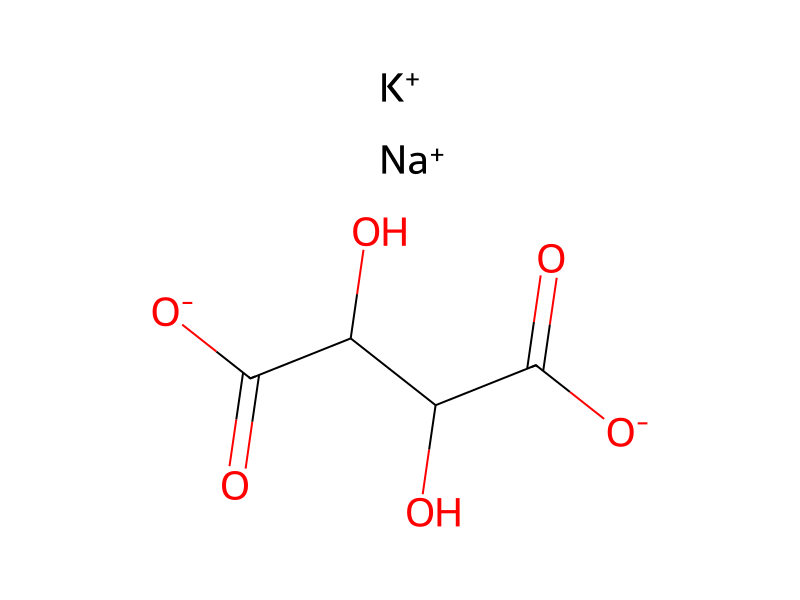
Potassium sodium tartarate → HCID 22338185, compound
Reaction equation

[H-].[Al+3].[Li+].[H-].[H-].[H-].C(O[C:10]([C:12]1[N:13]([CH2:22][C:23]#[N:24])[C:14]2[C:19]([CH:20]=1)=[C:18]([Br:21])[CH:17]=[CH:16][CH:15]=2)=O)C.C(C(C(C([O-])=O)O)O)([O-])=O.[Na+].[K+]>C(OCC)C>[Br:21][C:18]1[C:19]2[CH:20]=[C:12]3[CH2:10][NH:24][CH2:23][CH2:22][N:13]3[C:14]=2[CH:15]=[CH:16][CH:17]=1Participants




Procedure
Lithium aluminiumhydride (4.0 g, 106 mmol) was suspended in diethylether (600 mL) and 4-bromo-1-cyanomethyl-1H-indole-2-carboxylic acid ethyl ester (13.0 g, 42 mmol) was added in portions. The mixture was boiled for 15 h, cooled to room temperature and added to saturated potassium sodium tartrate solution. Thorough washing of the filter-cake with ethyl acetate followed the filtration over Celite® to remove solids. The phases of the filtrate were separated and the water phase was extracted with ethylacetate. The organic phases were pooled, washed with brine, dried with MgSO4 and the solvent was evaporated. Chromatography on silica gel (dichloromethane/methanol 95:5) yielded 9-bromo-1,2,3,4-tetrahydro-pyrazino[1,2-a]indole (3.6 g, 34%) as a colorless solid, MS: m/e=250.0 (M+).
Workup
- washThorough washing of the
- filtrationfilter-cake with ethyl acetate
- filtrationthe filtration over Celite®
- customto remove solids
- customThe phases of the filtrate were separated
- extractionthe water phase was extracted with ethylacetate
- washwashed with brine
- dry with materialdried with MgSO4
- customthe solvent was evaporated
Sources & evidence
- ORD record
- ord-5b311aabb062494ba4823edfb3a67a86
- Source dataset
- uspto-grants-2005_08
- Patent number
- US06933387B2
Reaction notes
Loading…