HuagongsheHuagongshe Chemistry Print Report · For research reference only
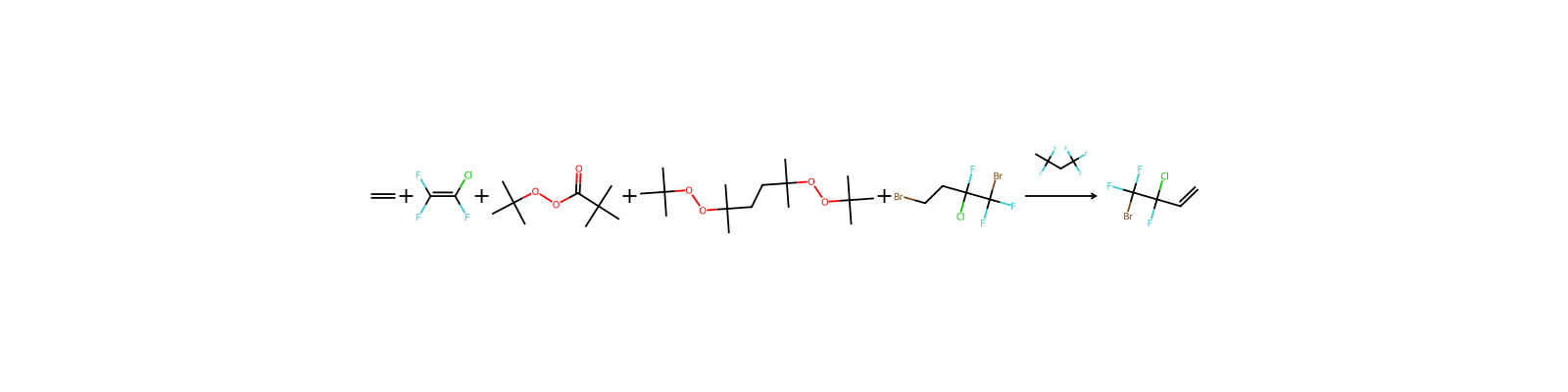
Ethylene → 4-Bromo-3-chloro-3,4,4-trifluorobut-1-ene
Participants
| Role | Name | HCID | Charge |
|---|---|---|---|
| Reactant | Ethylene | HCID 6325 | — |
| Reactant | 2,5-Dimethyl-2,5-di-(tert-butylperoxy)hexane | HCID 6545 | — |
| Reactant | Chlorotrifluoroethylene | HCID 6594 | — |
| Reactant | tert-BUTYL PEROXYPIVALATE | HCID 61238 | — |
| Reactant | 1,4-Dibromo-2-chloro-1,1,2-trifluorobutane | HCID 136221 | — |
| Solvent | 1,1,1,3,3-Pentafluorobutane | HCID 67884 | — |
| Product | 4-Bromo-3-chloro-3,4,4-trifluorobut-1-ene | HCID 136217 | — |
Reaction Steps
A supply of BCTFB was obtained by reacting ethylene with dibrominated CTFE in 1,1,1,3,3-pentafluorobutane at 120° C. for 4 hours using a mixture of tert-butyl peroxypivalate (TBPPi, 3 mol %) and 2,5-bis(tert-butylperoxy)-2,5-dimethylhexane (Trigonox 101, 4.5 mol %) as radical initiators, with the resulting structure being Br—CF2—CFCl—CH2—CH2—Br after distillation under vacuum. This was dehydrochlorinated with KOH in refluxing methanol for 15 hours, forming Br—CF2—CFCl—CH═CH2 (BCTFB). Successful radical copolymerization of CTFE (96 mol % in the feed) with BCTFB initiated by TBPPi (2 mol % with respect to both monomers) was carried out at 74° C. in a 100 mL autoclave. The 19F NMR spectrum of the obtained polymer is shown in FIG. 7.
Provenance & Evidence
| DOI | 10.6084/m9.figshare.5104873.v1 |
|---|---|
| Patent number | US09234062B2 |
| Source dataset | uspto-grants-2016_01 |
| ORD ID | ord-1bac611b9d77408f8d1b37e1104a652a |
| Source note | uspto-grants-2016_01 |