4-Fluoroaniline → 4-Fluoroaniline
Reaction equation
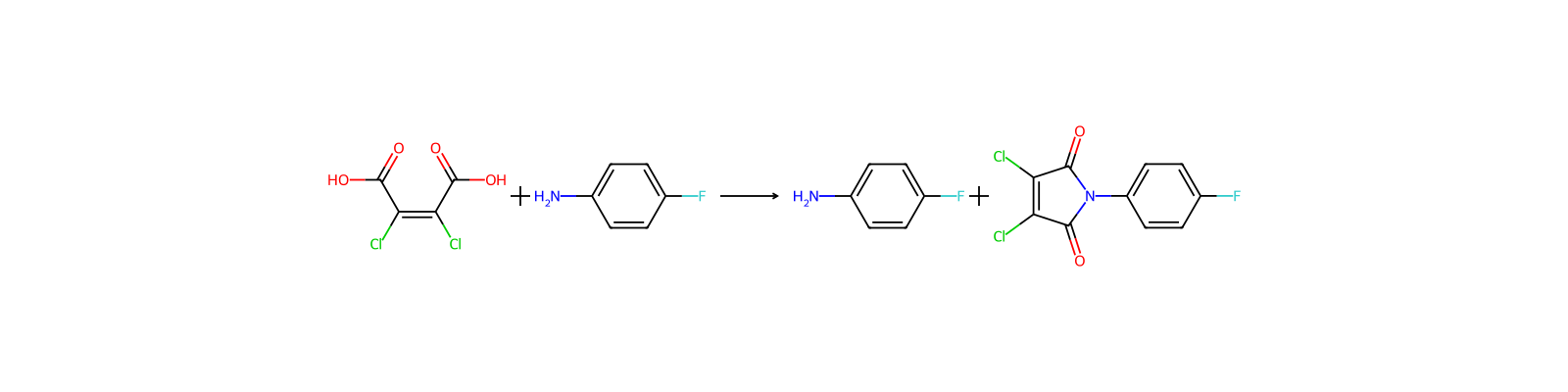
[Cl:1]/[C:2](=[C:6](\[Cl:10])/[C:7](O)=[O:8])/[C:3](O)=[O:4].[F:11][C:12]1[CH:18]=[CH:17][C:15]([NH2:16])=[CH:14][CH:13]=1>>[F:11][C:12]1[CH:18]=[CH:17][C:15]([NH2:16])=[CH:14][CH:13]=1.[F:11][C:12]1[CH:18]=[CH:17][C:15]([N:16]2[C:3](=[O:4])[C:2]([Cl:1])=[C:6]([Cl:10])[C:7]2=[O:8])=[CH:14][CH:13]=1Participants


Procedure
To react 2,3-dichloromaleic acid, an anhydride or an ester thereof with 4-fluoroaniline, the latter may be added to the former dropwise with mixing. In this case, however, if the reaction is carried out at higher temperature, for example at reflux temperatures, then byproducts tend to be formed through the reaction of p-fluoroaniline with N-(4-fluorophenyl)-2,3-dichloromaleimide, thereby reducing the purity of the product. This danger may be eliminated by employment of a two-stage reaction method wherein the starting material is mixed with 4-fluoroaniline dropwise at comparatively lower temperatures (first stage) and then the reaction is completed at elevated temperatures (second stage) to minimize the formation of byproducts. The reaction temperature for the first stage is lower than 60° C, preferably in the range of room temperature -- 50° C; the reaction temperature for the second stage is preferably in the range of 60° C to reflux temperature. When the reaction is to be effected in a single stage, it is advisable to add 4-fluoroaniline dropwise into 2,3-dichloromaleic acid, an anhydride or an ester thereof. Whereas when a two-stage reaction is adopted, the desired product may be obtained at a similar high yield by adding the former to the latter dropwise or vice versa. The reaction time is not specially limited and may be selected within a wide range: the reaction may usually be fully completed within 1-6 hours. In the two-stage reaction the dropping time for the first stage may be in the range of 10-60 minutes and the reaction time for the second stage may be in the range of 1-6 hours. In this way the desired substance may be obtained at a high purity after completion of the reaction by merely cooling the reaction mixture and then separating the crystals by filtration.
Workup
- additionwith mixing
- temperatureat reflux temperatures
Sources & evidence
- ORD record
- ord-b30bcd5c17b043508d7b4fbfe21433a6
- Source dataset
- uspto-grants-1977_03
- Patent number
- US04010182
Reaction notes
Loading…