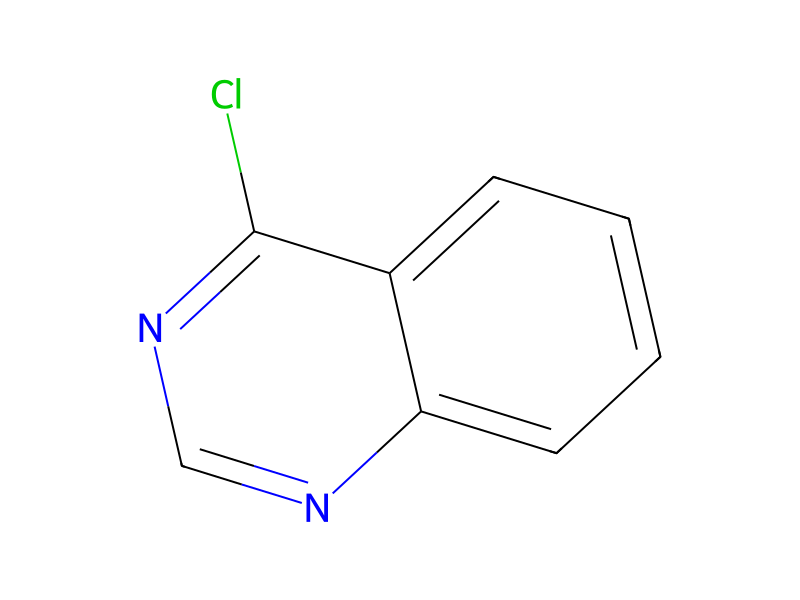
4-Chloroquinazoline → Ethyl 1-quinazolin-4-ylindolin-3-ylacetate
Reaction equation

Cl[C:2]1[C:11]2[C:6](=[CH:7][CH:8]=[CH:9][CH:10]=2)[N:5]=[CH:4][N:3]=1.[NH:12]1[C:20]2[C:15](=[CH:16][CH:17]=[CH:18][CH:19]=2)[CH:14]([CH2:21][C:22]([O:24][CH2:25][CH3:26])=[O:23])[CH2:13]1>COCCOC>[N:5]1[C:6]2[C:11](=[CH:10][CH:9]=[CH:8][CH:7]=2)[C:2]([N:12]2[C:20]3[C:15](=[CH:16][CH:17]=[CH:18][CH:19]=3)[CH:14]([CH2:21][C:22]([O:24][CH2:25][CH3:26])=[O:23])[CH2:13]2)=[N:3][CH:4]=1Participants
4
Reactant 2

Product 1

Reagents, catalysts & solvents 1

Procedure
A mixture of 4-chloroquinazoline (2.3g.) and ethyl indolin-3-ylacetate (2.6g.) in 1,2-dimethoxyethane (30ml.) was heated under reflux for 15 minutes. The mixture was cooled and filtered, and the solid residue was dissolved in ice-water (40ml.). To the solution was added saturated sodium acetate solution (10ml.), and the mixture was extracted with ethyl acetate (3 × 50ml.). The combined extracts were dried (Na2SO4), and the solvent evaporated in vacuo to give ethyl 1-quinazolin-4-ylindolin-3-ylacetate as a syrup which was proved to be pure by TLC (system A).
Workup
- temperaturewas heated
- temperatureunder reflux for 15 minutes
- temperatureThe mixture was cooled
- filtrationfiltered
- dissolutionthe solid residue was dissolved in ice-water (40ml.)
- additionTo the solution was added saturated sodium acetate solution (10ml.)
- extractionthe mixture was extracted with ethyl acetate (3 × 50ml.)
- dry with materialThe combined extracts were dried (Na2SO4)
- customthe solvent evaporated in vacuo
Sources & evidence
- ORD record
- ord-dcde0069e29d44d29c10c2b03b9f218d
- Source dataset
- uspto-grants-1977_03
- Patent number
- US04012513
Reaction notes
Loading…