4-Hydroxybenzoic Acid → 4-Hydroxycyclohexanecarboxylic acid
Reaction equation

[OH:1][C:2]1[CH:10]=[CH:9][C:5]([C:6]([OH:8])=[O:7])=[CH:4][CH:3]=1.[OH-].[K+]>[Pt]=O.C(O)C>[OH:1][CH:2]1[CH2:10][CH2:9][CH:5]([C:6]([OH:8])=[O:7])[CH2:4][CH2:3]1Participants
5
Reactant 2
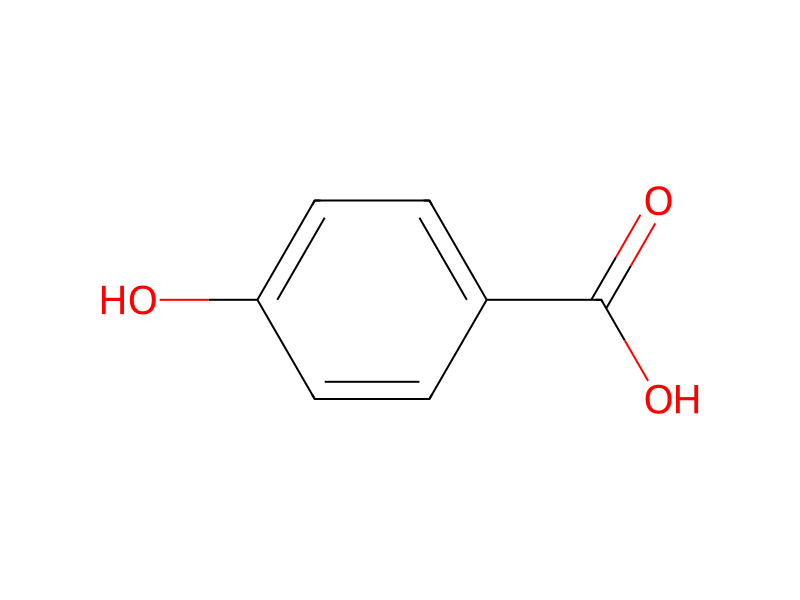

Product 1

Reagents, catalysts & solvents 2


Procedure
A mixture of 42 parts of p-hydroxybenzoic acid, 2 parts of platinum oxide, 1 part of 10% aqueous potassium hydroxide and 150 parts by volume of ethanol was charged to a hydrogenation flask. The mixture was hydrogenated at 50 psi for 32 hours. The reaction mixture was filtered and the solvent evaporated. The solid product was slurried in 500 parts by volume of hot cyclohexane to remove cyclohexane carboxylic acid, filtered, and the solids recrystallized from 100 parts of water. The solid, unreacted p-hydroxybenzoic acid, was filtered off and the water evaporated yielding 16 parts of 4-hydroxycyclohexane carboxylic acid having a melting point of 110°-130° C.
Workup
- additionwas charged to a hydrogenation flask
- filtrationThe reaction mixture was filtered
- customthe solvent evaporated
- customto remove cyclohexane carboxylic acid
- filtrationfiltered
- customthe solids recrystallized from 100 parts of water
- filtrationThe solid, unreacted p-hydroxybenzoic acid, was filtered off
- customthe water evaporated
Sources & evidence
- ORD record
- ord-840576af1f5e4f3d97cfcc0f61f61e7f
- Source dataset
- uspto-grants-1977_03
- Patent number
- US04013582
Reaction notes
Loading…