Methanol → N-(4-methoxybenzyl)-5-(isoquinolin-6-yl)oxazol-2-amine
Reaction equation

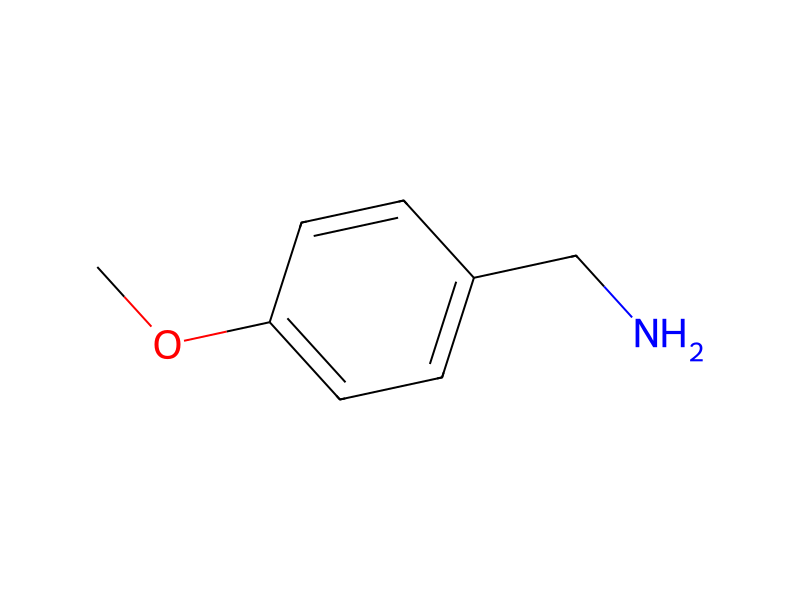
I[C:2]1[O:3][C:4]([C:7]2[CH:8]=[C:9]3[C:14](=[CH:15][CH:16]=2)[CH:13]=[N:12][CH:11]=[CH:10]3)=[CH:5][N:6]=1.[CH3:17][O:18][C:19]1[CH:24]=[CH:23][C:22]([CH2:25][NH2:26])=[CH:21][CH:20]=1.CN1C(=O)CCC1.CO>C(Cl)Cl>[CH3:17][O:18][C:19]1[CH:24]=[CH:23][C:22]([CH2:25][NH:26][C:2]2[O:3][C:4]([C:7]3[CH:8]=[C:9]4[C:14](=[CH:15][CH:16]=3)[CH:13]=[N:12][CH:11]=[CH:10]4)=[CH:5][N:6]=2)=[CH:21][CH:20]=1Participants





Conditions
- Temperature
- 165 °C
Procedure
A glass microwave reaction vessel was charged with 6-(2-iodooxazol-5-yl)isoquinoline (0.10 g, 310 μmol), (4-methoxyphenyl)methanamine (0.28 mL, 217 μmol) and NMP (2.00 mL). The reaction mixture was stirred and heated in a Smith Synthesizer® microwave reactor (Personal Chemistry, Inc., Upssala, Sweden) at 165° C. for 10 minutes. The residual product was adsorbed onto a plug of silica gel and chromatographed through two stacked Redi-Sep® pre-packed silica gel column (12 g), eluting with a gradient of 1% to 10% of 2 M NH3.MeOH in DCM to provide N-(4-methoxybenzyl)-5-(isoquinolin-6-yl)oxazol-2-amine (98 mg, 95% yield). LCMS (API-ES) m/z (%): 332.1 (100%, M++H); 1H NMR (400 MHz, MeOH-d4) δ ppm 9.12 (s, 1H) 8.38 (d, J=5.87 Hz, 1H) 8.04 (d, J=8.80 Hz, 1H) 7.94 (s, 1H) 7.84 (dd, J=8.61, 1.56 Hz, 1H) 7.76 (d, J=5.87 Hz, 1H) 7.42 (s, 1H) 7.33 (d, J=8.80 Hz, 2H) 6.90 (d, J=8.61 Hz, 2H) 4.47 (s, 2H) 3.77 (s, 3H).
Workup
- customA glass microwave reaction vessel
- customchromatographed through two stacked Redi-Sep® pre-packed silica gel column (12 g)
- washeluting with a gradient of 1% to 10% of 2 M NH3
Sources & evidence
- ORD record
- ord-c94b6edac5c542458fd4522f8d61b855
- Source dataset
- uspto-grants-2011_03
- Patent number
- US07897619B2
Reaction notes
Loading…