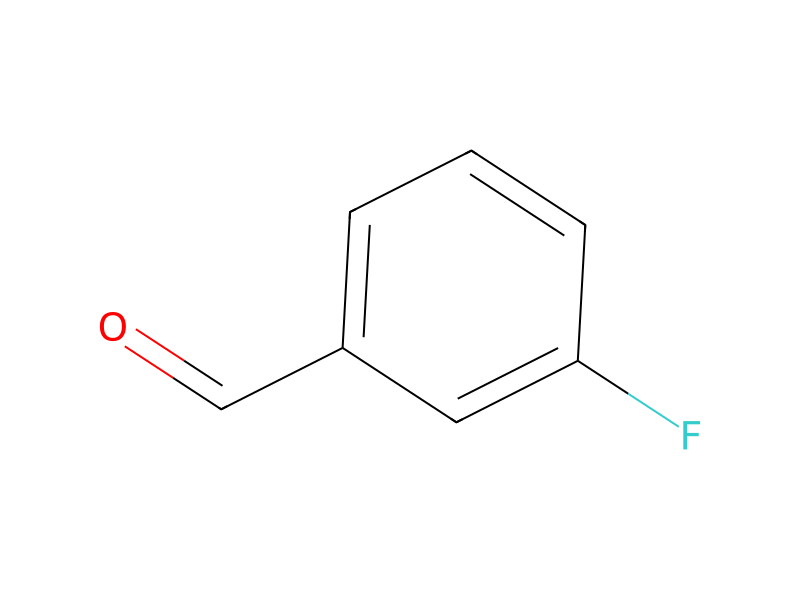
3-Fluorobenzaldehyde → HCID 10087234, compound
Reaction equation

[F:1][C:2]1[CH:3]=[C:4]([CH:7]=[CH:8][CH:9]=1)[CH:5]=O.[CH2:10]([O:12][C:13](=[O:24])[NH:14][C:15]1[CH:20]=[CH:19][C:18]([NH2:21])=[CH:17][C:16]=1[O:22][CH3:23])[CH3:11]>CO>[CH2:10]([O:12][C:13](=[O:24])[NH:14][C:15]1[CH:20]=[CH:19][C:18]([NH:21][CH2:5][C:4]2[CH:7]=[CH:8][CH:9]=[C:2]([F:1])[CH:3]=2)=[CH:17][C:16]=1[O:22][CH3:23])[CH3:11]Participants
4
Reactant 2

Product 1

Reagents, catalysts & solvents 1

Conditions
- Temperature
- 40 °C
Procedure
A solution of 3-fluorobenzaldehyde in dry methanol (84 μL, 476 mM) was added to a solution of (4-Amino-2-methyloxyphenyl)-carbamic acid ethyl ester (84 μL, 0.476 M in dry methanol). The resulting mixture was heated to 40° C. for 30 minutes. The solvent was evaporated in vacuo, and the remaining material was dissolved in 1,2-dichloroethane (1 mL). Sodium triacetoxyborohydrate (20 mg) was added, and the resulting mixture was kept at room temperature for 2 hours, under 2 periods of sonication for 10 minutes, respectively. The reaction mixture was filtered through silica gel (500 mg), and the column was washed with 1,2-dichloroethane (3 mL). The solvent was evaporated in vacuo yielding the title compound (5.7 mg, 45%).
Workup
- customThe solvent was evaporated in vacuo
- dissolutionthe remaining material was dissolved in 1,2-dichloroethane (1 mL)
- additionSodium triacetoxyborohydrate (20 mg) was added
- customthe resulting mixture was kept at room temperature for 2 hours, under 2 periods of sonication for 10 minutes
- filtrationThe reaction mixture was filtered through silica gel (500 mg)
- washthe column was washed with 1,2-dichloroethane (3 mL)
- customThe solvent was evaporated in vacuo
Sources & evidence
- ORD record
- ord-a071de20d7a240c094ec0a8b44701356
- Source dataset
- uspto-grants-2011_03
- Patent number
- US07906537B2
Reaction notes
Loading…