4-Methylmorpholine → N-({4-[(2R,3R)-3-{[2-(1,3-benzodioxol-5-yl)-2-hydroxyethyl]thio}-1-(4-fluorophenyl)-4-oxoazetidin-2-yl]phenoxy}acetyl)glycyl-D-lysine
Reaction equation

[O:1]1[C:5]2[CH:6]=[CH:7][C:8]([CH:10]([OH:40])[CH2:11][S:12][C@H:13]3[C:16](=[O:17])[N:15]([C:18]4[CH:23]=[CH:22][C:21]([F:24])=[CH:20][CH:19]=4)[C@@H:14]3[C:25]3[CH:39]=[CH:38][C:28]([O:29][CH2:30][C:31]([NH:33]CC(O)=O)=[O:32])=[CH:27][CH:26]=3)=[CH:9][C:4]=2[O:3][CH2:2]1.Cl.C(OC(NCCCC[C@H](C(OC(C)(C)C)=O)N)=O)(C)(C)C.CN1CCOCC1.CN(C(ON1N=NC2C=CC=CC1=2)=[N+](C)C)C.[B-](F)(F)(F)F.O1C2C=CC(C(O)CS[C@H]3C(=O)N(C4C=CC(F)=CC=4)[C@@H]3C3C=CC(OCC(N[CH2:125][C:126]([NH:128][C@@H:129]([C:142]([O:144]C(C)(C)C)=[O:143])[CH2:130][CH2:131][CH2:132][CH2:133][NH:134]C(OC(C)(C)C)=O)=[O:127])=O)=CC=3)=CC=2OC1>C(Cl)Cl>[O:1]1[C:5]2[CH:6]=[CH:7][C:8]([CH:10]([OH:40])[CH2:11][S:12][C@H:13]3[C:16](=[O:17])[N:15]([C:18]4[CH:23]=[CH:22][C:21]([F:24])=[CH:20][CH:19]=4)[C@@H:14]3[C:25]3[CH:26]=[CH:27][C:28]([O:29][CH2:30][C:31]([NH:33][CH2:125][C:126]([NH:128][C@@H:129]([C:142]([OH:144])=[O:143])[CH2:130][CH2:131][CH2:132][CH2:133][NH2:134])=[O:127])=[O:32])=[CH:38][CH:39]=3)=[CH:9][C:4]=2[O:3][CH2:2]1Participants
Reactant 5
 HCID 79724-Methylmorpholine
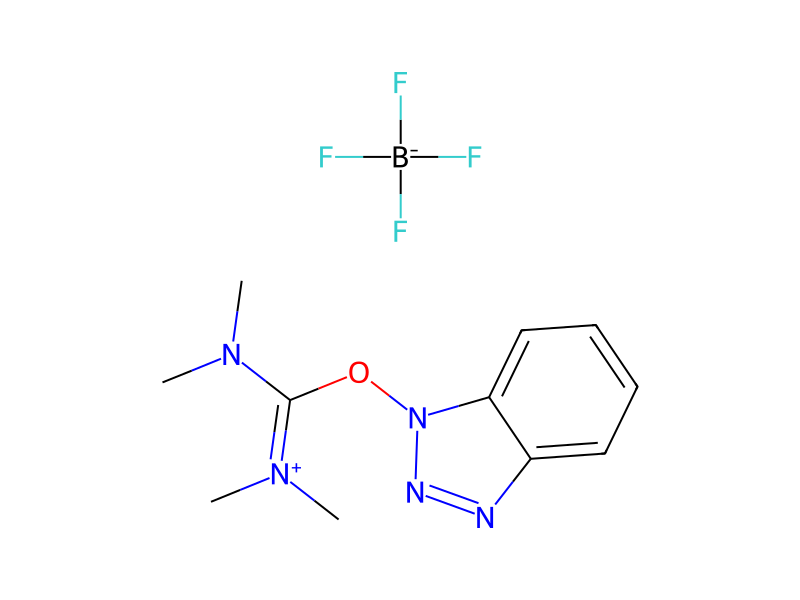 HCID 2733207O-(Benzotriazol-1-yl)-N,N,N',N'-tetramethyluronium tetrafluoroborate
 HCID 56777341H-D-Lys(boc)-otbu hcl
 HCID 67270896tert-butyl N-({4-[(2R,3R)-3-{[2-(1,3-benzodioxol-5-yl)-2-hydroxyethyl]thio}-1-(4-fluorophenyl)-4-oxoazetidin-2-yl]phenoxy}acetyl)glycyl-N6-(tert-butoxycarbonyl)-D-lysinate
 HCID 67271334N-({4-[(2R,3R)-3-{[2-(1,3-benzodioxol-5-yl)-2-hydroxyethyl]thio}-1-(4-fluorophenyl)-4-oxoazetidin-2-yl]phenoxy}acetyl)glycine
Product 1

Reagents, catalysts & solvents 1

Procedure
To a stirred solution of N-({4-[(2R,3R)-3-{[2-(1,3-benzodioxol-5-yl)-2-hydroxyethyl]thio}-1-(4-fluorophenyl)-4-oxoazetidin-2-yl]phenoxy}acetyl)glycine (11.3 mg, 0.020 mmol) in DCM (2 ml) were added tert-butyl N6-(tert-butoxycarbonyl)-D-lysinate hydrochloride (9.5 mg, 0.028 mmol), N-methylmorpholine (15 μl, 0.091 mmol) and TBTU (11.0 mg, 0.034 mmol). The reaction mixture was stirred at ambient temperature for 3 hours. The formation of the intermediate tert-butyl N-({4-[(2R,3R)-3-{[2-(1,3-benzodioxol-5-yl)-2-hydroxyethyl]thio}-1-(4-fluorophenyl)-4-oxoazetidin-2-yl]phenoxy}acetyl)glycyl-N6-(tert-butoxycarbonyl)-D-lysinate was confirmed. M/z: 852.23 (M−1). The solvent was removed under reduced pressure and the residue was dissolved in formic acid (2 ml). The mixture was stirred at ambient temperature for 48 hours. The solvent was co-evaporated with toluene and the residue was purified with preparative HPLC on a C8 column, UV 240/260 nm. A gradient from 20 to 45% MeCN in 0.1M NH4OAc buffer was used as eluent. The MeCN was removed under reduced pressure and the residue was lyophilised to give the title. H-NMR (400 MHz, DMSO-d6): 1.08-1.32 (m, 2H), 1.37-65 (m, 4H), 2.63 (t, 2H), 2.77-2.92 (m, 2H), 3.70 (d, 2H), 3.76-3.82 (m, 1H), 4.25 (d, 0.5H), 4.28 (d, 0.5H), 4.50 (s, 2H), 4.57-4.64 (m, 1H), 5.00 (d, 0.5H), 5.02 (d, 0.5H), 5.90-5.94 (m, 2H), 6.70-6.81 (m, 2H), 6.83 (s, 1H), 6.96 (d, 2H), 7.08-7.16 (m, 2H), 7.17-7.24 (m, 2H), 7.34 (d, 2H), 7.45-7.55 (m, 1H), 8.37-8.43 (m, 1H). M/z: 697.32 (M+1) and 695.39 (M−1).
Workup
- customThe solvent was removed under reduced pressure
- dissolutionthe residue was dissolved in formic acid (2 ml)
- stirringThe mixture was stirred at ambient temperature for 48 hours
- customthe residue was purified with preparative HPLC on a C8 column, UV 240/260 nm
- customThe MeCN was removed under reduced pressure
- customto give the title
Sources & evidence
- ORD record
- ord-f2c26b6e1ca447fe99f4d27a77219e1a
- Source dataset
- uspto-grants-2011_03
- Patent number
- US07906502B2
Reaction notes
Loading…