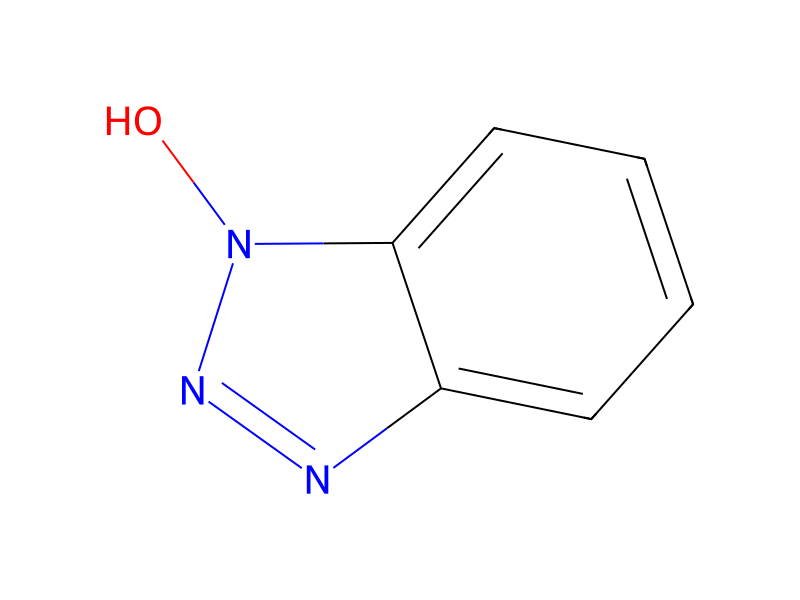
1-Hydroxybenzotriazole → (2S,4S)-4-fluoro-1-(2-hydroxyacetyl)pyrrolidine-2-carboxamide
Reaction equation

Cl.[F:2][C@@H:3]1[CH2:7][NH:6][C@H:5]([C:8]([O:10]C)=O)[CH2:4]1.C([N:15](C(C)C)CC)(C)C.ON1C2C=CC=CC=2N=N1.C([O:34][CH2:35][C:36]([OH:38])=O)(=O)C.Cl.C(N=C=NCCCN(C)C)C>C(#N)C>[F:2][C@@H:3]1[CH2:7][N:6]([C:36](=[O:38])[CH2:35][OH:34])[C@H:5]([C:8]([NH2:15])=[O:10])[CH2:4]1Participants
Reactant 5


Product 1

Reagents, catalysts & solvents 1
Procedure
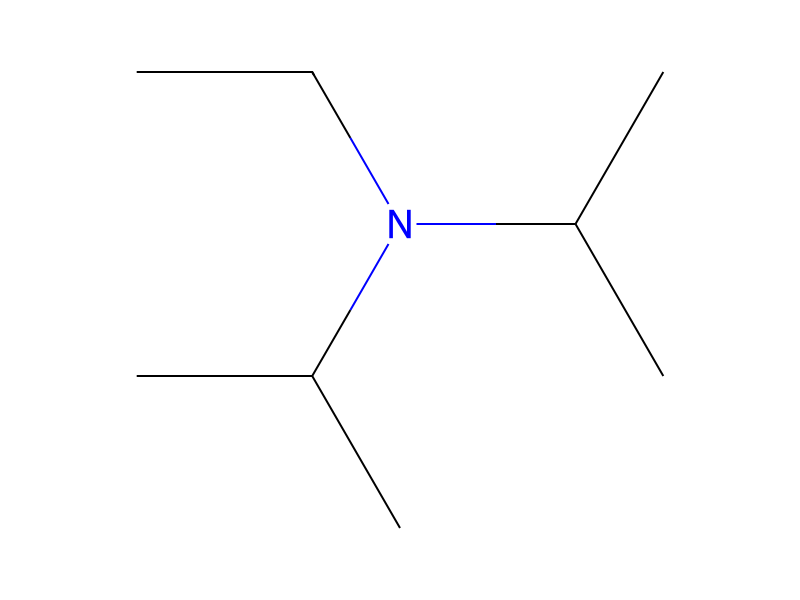
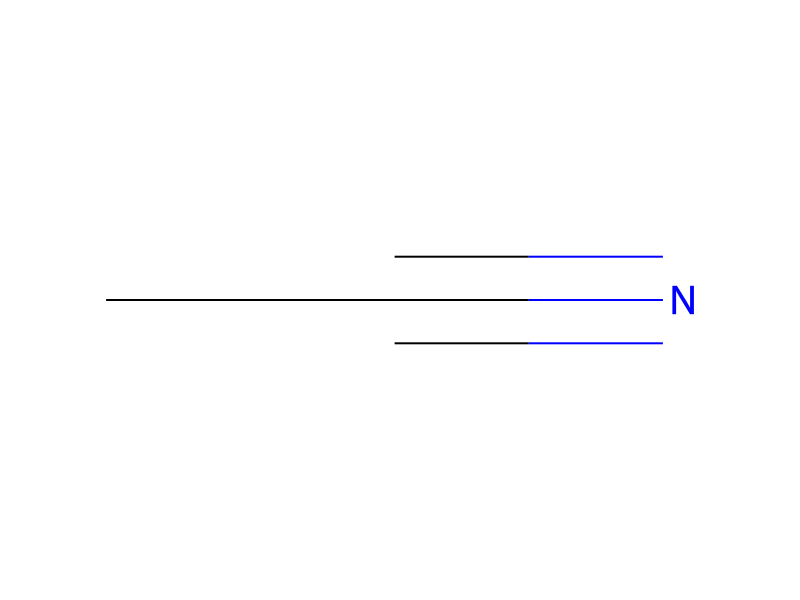
Process A: Methyl (2S,4S)-4-fluoropyrrolidine-2-carboxylate hydrochloride (18.4 g) was suspended in dehydrated acetonitrile (370 mL). While the suspension was cooled in an ice bath, diisopropylethylamine (18.3 mL) was added dropwise and the mixture was stirred for 15 minutes. Subsequently, 1-hydroxybenzotriazole (4.59 g), glycolic acid (8.37 g) and 3-ethyl-1-(3-dimethylaminopropyl)carbodiimide hydrochloride (23.0 g) were added and the reaction mixture was stirred at room temperature for 6 hours and left overnight. The reaction mixture was then concentrated under reduced pressure and the resulting residue was purified on a silica gel column (eluant=ethyl acetate:methanol=10:1). The eluted yellow oil was dissolved in dehydrated methanol (50 mL). While being cooled in an ice bath, the solution was added to methanol (250 mL) saturated with ammonia. The mixture was stirred at room temperature for 3 hours. The resulting crystal was collected by filtration, washed with methanol, and dried under reduced pressure to give (2S,4S)-4-fluoro-1-(2-hydroxyacetyl)pyrrolidine-2-carboxamide as a white crystal (15.6 g, 82% yield). Process B: Methyl (2S,4S)-4-fluoropyrrolidine-2-carboxylate hydrochloride (1.84 g) was suspended in dehydrated acetonitrile (37 mL). While the suspension was cooled in an ice bath, diisopropylethylamine (1.83 mL) was added dropwise and the mixture was stirred for 15 minutes. Subsequently, 1-hydroxybenzotriazole (0.46 g), acetoxyacetic acid (1.30 g) and 3-ethyl-1-(3-dimethylaminopropyl)carbodiimide hydrochloride (2.30 g) were added and the mixture was stirred at room temperature for 4 hours and left overnight. The reaction mixture was then concentrated under reduced pressure and the resulting residue was dissolved in ethyl acetate (150 mL). The solution was washed successively with water (20 mL), a saturated aqueous sodium bicarbonate solution (20 mL) and saturated brine (20 mL). The washes were combined and sodium chloride was added to saturation. The resulting mixture was extracted with ethyl acetate (100 mL×2). The ethyl acetate extracts were combined, dried over anhydrous sodium sulfate, and concentrated under reduced pressure. The resulting residue was dissolved in methanol (30 mL) saturated with ammonia and the solution was stirred at room temperature for 4 hours. The resulting crystal was collected by filtration, washed with methanol, and dried under reduced pressure to give (2S,4S)-4-fluoro-1-(2-hydroxyacetyl)pyrrolidine-2-carboxamide as a white crystal (1.50 g, 79% yield). Process C: Methyl (2S,4S)-4-fluoropyrrolidine-2-carboxylate hydrochloride (1.84 g) was suspended in dehydrated acetonitrile (30 mL). While the suspension was cooled in an ice bath, triethylamine (3.10 mL) was added dropwise and the mixture was stirred for 30 minutes. To the reaction mixture, acetoxyacetyl chloride (1.13 mL) was added dropwise at the same temperature and the mixture was further stirred for 1 hour. The insoluble material in the reaction mixture was collected by filtration and washed with acetonitrile. The filtrate and the wash were combined and concentrated under reduced pressure. The resulting residue was dissolved in ethyl acetate (150 mL) and the solution was washed successively with water (20 mL) and saturated brine (2×20 mL). The washes were combined and sodium chloride was added to saturation. The resulting mixture was extracted with ethyl acetate (100 mL×2). The ethyl acetate extracts were combined, dried over anhydrous sodium sulfate, and concentrated under reduced pressure. The residue was dissolved in methanol (30 mL) saturated with ammonia and the solution was stirred at room temperature for 2.5 hours. The resulting crystal was collected by filtration, washed with methanol, and dried under reduced pressure to give (2S,4S)-4-fluoro-1-(2-hydroxyacetyl)pyrrolidine-2-carboxamide as a white crystal (1.42 g, 76% yield).
Workup
- temperatureWhile the suspension was cooled in an ice bath
- stirringthe mixture was stirred at room temperature for 4 hours
- waitleft overnight
- concentrationThe reaction mixture was then concentrated under reduced pressure
- dissolutionthe resulting residue was dissolved in ethyl acetate (150 mL)
- washThe solution was washed successively with water (20 mL)
- additionsodium chloride was added to saturation
- extractionThe resulting mixture was extracted with ethyl acetate (100 mL×2)
- dry with materialdried over anhydrous sodium sulfate
- concentrationconcentrated under reduced pressure
- dissolutionThe resulting residue was dissolved in methanol (30 mL) saturated with ammonia
- stirringthe solution was stirred at room temperature for 4 hours
- filtrationThe resulting crystal was collected by filtration
- washwashed with methanol
- customdried under reduced pressure
Sources & evidence
- ORD record
- ord-0752d34472e64961a31519c49d7c23be
- Source dataset
- uspto-grants-2011_03
- Patent number
- US07915427B2
Reaction notes
Loading…