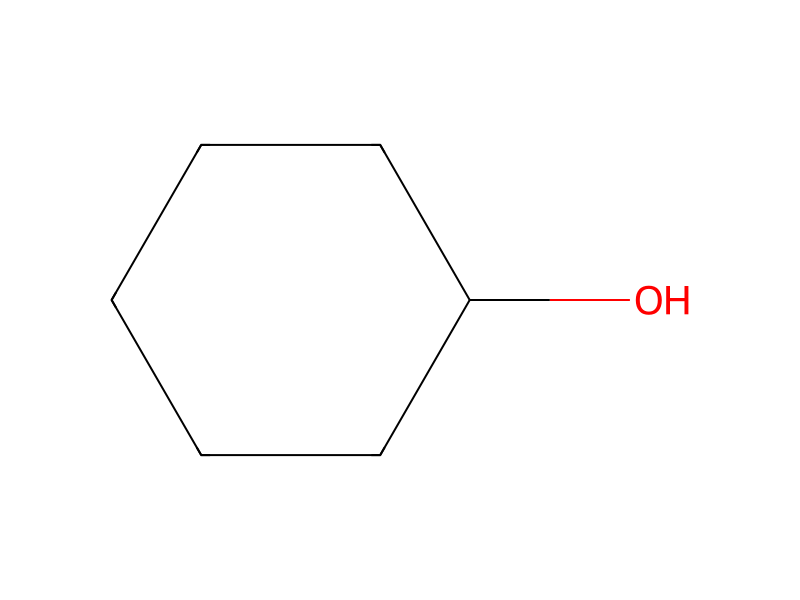
Cyclohexane → Cyclohexanol
Reaction equation

[CH2:1]1[CH2:6][CH2:5][CH2:4][CH2:3][CH2:2]1.ClC1C=CC=C(Cl)[N+]=1[O-:15]>[2H]C1C([2H])=C([2H])C([2H])=C([2H])C=1[2H]>[C:1]1(=[O:15])[CH2:6][CH2:5][CH2:4][CH2:3][CH2:2]1.[CH:1]1([OH:15])[CH2:6][CH2:5][CH2:4][CH2:3][CH2:2]1Participants
5
Reactant 2


Product 2

Reagents, catalysts & solvents 1

Conditions
- Temperature
- 75 °C
Procedure
A solution containing 1M cyclohexane, 0.625M 2,6-dichloropyridine N-oxide and 0.10 mM [Ru(TPFPP)(NO)(H2O)](SbF6) in 1 ml d6 -benzene was heated for eight hours in a sealed tube at 75° C. affording high yields of oxidized products. A combined yield of 93% and 1500 catalytic turnovers were obtained of two products, cyclohexanone and cyclohexanol (mole ratio 4:1). In CD2Cl2 the same reaction conditions proceeded to give 5600 turnovers to generate cyclohexanone and cyclohexanol (8:1) in a combined 98% yield in twelve hours. 2,6-dichloropyridine-N-oxide was unable to hydroxylate cyclohexane by heat alone as shown by a control experiment, proving that the ruthenium complex must be present to effect reaction. ##STR8##
Workup
- customaffording high
- customyields of oxidized products
Sources & evidence
- ORD record
- ord-138f9668ca614035b421f58e8bd0638e
- Source dataset
- uspto-grants-1999_12
- Patent number
- US06002026
Reaction notes
Loading…