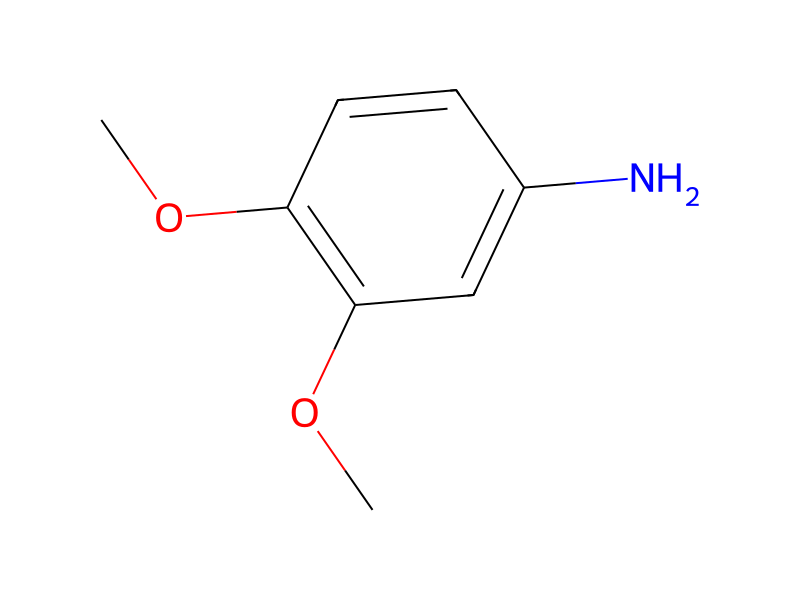
3,4-Dimethoxyaniline → HCID 5328843, compound
Reaction equation

Cl[C:2]1[C:11]2[C:6](=[CH:7][C:8]([O:14][CH3:15])=[C:9]([O:12][CH3:13])[CH:10]=2)[N:5]=[CH:4][C:3]=1[C:16]#[N:17].[CH3:18][O:19][C:20]1[CH:21]=[C:22]([CH:24]=[CH:25][C:26]=1[O:27][CH3:28])[NH2:23].C(OC(O)C)C>N1C=CC=CC=1>[CH3:18][O:19][C:20]1[CH:21]=[C:22]([NH:23][C:2]2[C:11]3[C:6](=[CH:7][C:8]([O:14][CH3:15])=[C:9]([O:12][CH3:13])[CH:10]=3)[N:5]=[CH:4][C:3]=2[C:16]#[N:17])[CH:24]=[CH:25][C:26]=1[O:27][CH3:28]Participants
5
Reactant 3


Product 1

Reagents, catalysts & solvents 1

Procedure
A mixture of 1.0 g of 4-chloro-6,7-dimethoxy-3-quinolinecarbonitrile, 1.22 g of 3,4-dimethoxyaniline, 0.32 ml of pyridine, and 12 ml of ethoxyethanol was stirred, under nitrogen, at reflux temperature for 5 h. The mixture was cooled and partitioned with dichloromethane and aqueous sodium bicarbonate. The organic layer was washed with water, dried and evaporated. The residue was recrystalized from ethyl acetate to give 0.96 g of 4-[(3,4-dimethoxyphenyl)amino]-6,7-dimethoxy-3-quinolinecarbonitrile as a solid, mp 230-240° C.
Workup
- temperatureat reflux temperature for 5 h
- temperatureThe mixture was cooled
- custompartitioned with dichloromethane and aqueous sodium bicarbonate
- washThe organic layer was washed with water
- customdried
- customevaporated
- customThe residue was recrystalized from ethyl acetate
Sources & evidence
- ORD record
- ord-6ace5669ab89404498e53d076f840447
- Source dataset
- uspto-grants-1999_12
- Patent number
- US06002008
Reaction notes
Loading…