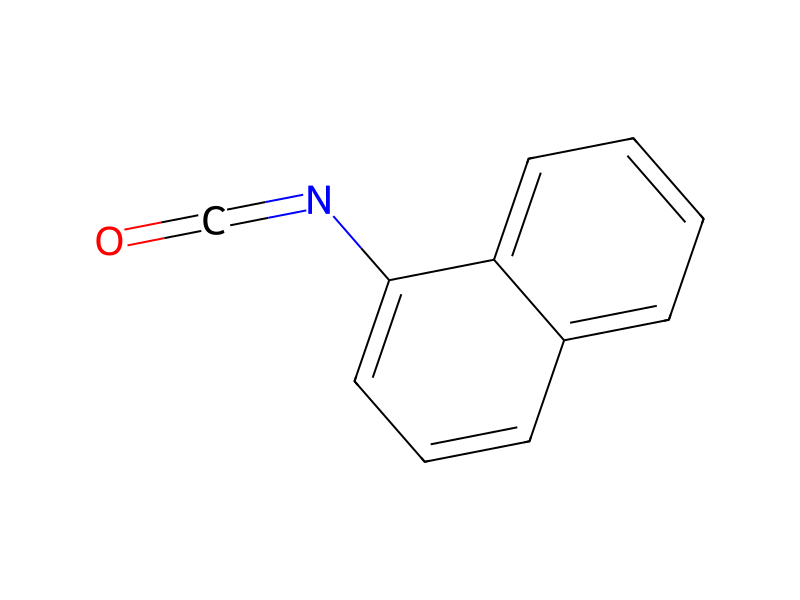
alpha-Naphthyl isocyanate → N-(2-Hydroxy-4-nitrophenyl)-N′-1-naphthalenylurea
Reaction equation

[OH:1][C:2]1[CH:8]=[C:7]([N+:9]([O-:11])=[O:10])[CH:6]=[CH:5][C:3]=1[NH2:4].[C:12]1([N:22]=[C:23]=[O:24])[C:21]2[C:16](=[CH:17][CH:18]=[CH:19][CH:20]=2)[CH:15]=[CH:14][CH:13]=1>>[OH:1][C:2]1[CH:8]=[C:7]([N+:9]([O-:11])=[O:10])[CH:6]=[CH:5][C:3]=1[NH:4][C:23]([NH:22][C:12]1[C:21]2[C:16](=[CH:17][CH:18]=[CH:19][CH:20]=2)[CH:15]=[CH:14][CH:13]=1)=[O:24]Participants
3


Procedure
N-(2-Hydroxy-4-nitrophenyl)-N'-(1-naphthyl)urea was prepared from 2-hydroxy 4-nitro aniline (500 mg, 3.24 mmol) and 1-naphthyl isocyanate (3.24 mmol) according to the procedure in General Method B. The product precipitated from methylene chloride and filtered. The resulting solid was titruated with 1:3 triethyl amino:methylene chloride. The filterate was concentrated in vacuo. The resulting residue was dissolved in methylene chloride and treated with 1 N HCl in water. The desired product precipitated from solution and was collected by filtration (0.11 g, 10%). EI-MS m/z 324 (M+H)+
Workup
- customThe product precipitated from methylene chloride
- filtrationfiltered
- concentrationThe filterate was concentrated in vacuo
- dissolutionThe resulting residue was dissolved in methylene chloride
- additiontreated with 1 N HCl in water
- customThe desired product precipitated from solution
- filtrationwas collected by filtration (0.11 g, 10%)
Sources & evidence
- ORD record
- ord-ebc5020468e545cf928b6560e8a5ce7f
- Source dataset
- uspto-grants-1999_12
- Patent number
- US06005008
Reaction notes
Loading…