Dibutyltin dichloride → HCID 178448241, compound
Reaction equation

[SH:1][C:2]1[N:6]=[C:5]([SH:7])[S:4][N:3]=1.[K].[K].[CH2:10]([Sn:14](Cl)(Cl)[CH2:15][CH2:16][CH2:17][CH3:18])[CH2:11][CH2:12][CH3:13]>C(O)C>[CH2:10]([Sn:14][CH2:15][CH2:16][CH2:17][CH3:18])[CH2:11][CH2:12][CH3:13].[SH:1][C:2]1[N:6]=[C:5]([SH:7])[S:4][N:3]=1Participants
4
Reactant 2
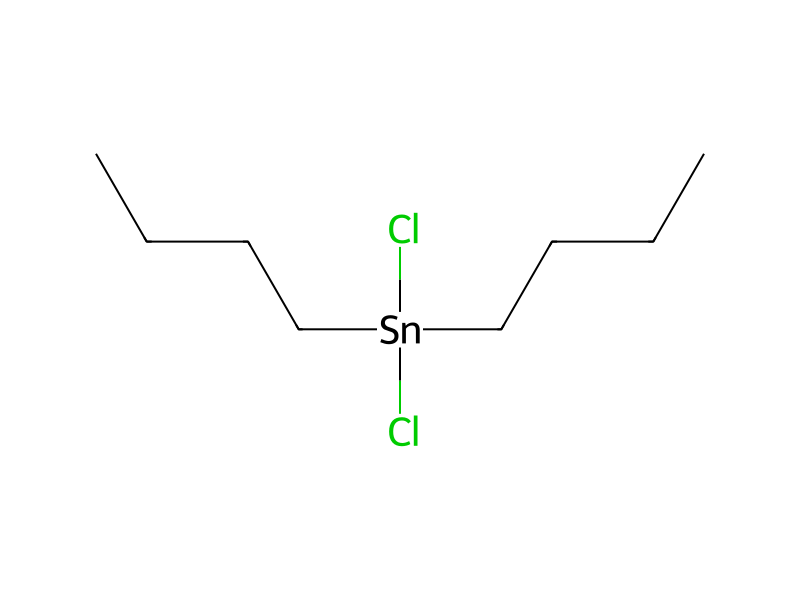

Product 1

Reagents, catalysts & solvents 1

Procedure
A solution of 5.9 g (0.026 m) of dipotassium 3,5-dimercapto-1,2,4-thiadiazole in 50 ml of ethanol was added slowly with agitation to an ethanol solution of 7.89 g (0.026 m) of dibutyltindichloride. The resulting reaction mixture was refluxed for 2 hours. A light yellow solid was isolated following several washes with ethanol and drying at 100° C. for 5 hours. Elemental analysis and other data of the product are recorded in Table III. The extreme pressure and antiwear characteristics of two base greases containing 5% of the solid product are listed in Table IV.
Workup
- customThe resulting reaction mixture
- temperaturewas refluxed for 2 hours
- customA light yellow solid was isolated
- customdrying at 100° C. for 5 hours
- additionThe extreme pressure and antiwear characteristics of two base greases containing 5% of the solid product
Sources & evidence
- ORD record
- ord-07b049c72e4644fd86e3ac1a19181264
- Source dataset
- uspto-grants-1985_02
- Patent number
- US04497719
Reaction notes
Loading…